

A Call for Awareness and Action: The Importance of Supportive Service Providers

Image: Two pairs of hands clasped together in a supportive hold. One person has blue painted nails and a tattoo visible on their forearm. The background is softly blurred green foliage.
Support Service Providers (SSPs) are specially trained professionals or volunteers who act as the eyes and ears for individuals who are DeafBlind. They primarily assist adults with dual sensory vision and hearing loss by providing sighted guide services, relaying visual and environmental information, and facilitating basic communication. SSPs are critical to the DeafBlind community because they do not act as caretakers who perform tasks for the individual; instead, they provide the necessary sensory access that empowers DeafBlind individuals to make their own decisions, perform everyday tasks such as shopping or banking, and maintain their independent living and autonomy.
We have written about SSPs before (see these previous articles). We have covered what they do, who they serve, and the funding crises that have left Colorado's Deafblind community without reliable access to these essential services. This article takes a different angle. Today, we want to talk about what happens when SSP access disappears, and the very clear choice that communities, policymakers, and funders make when they fail to fund these services adequately.
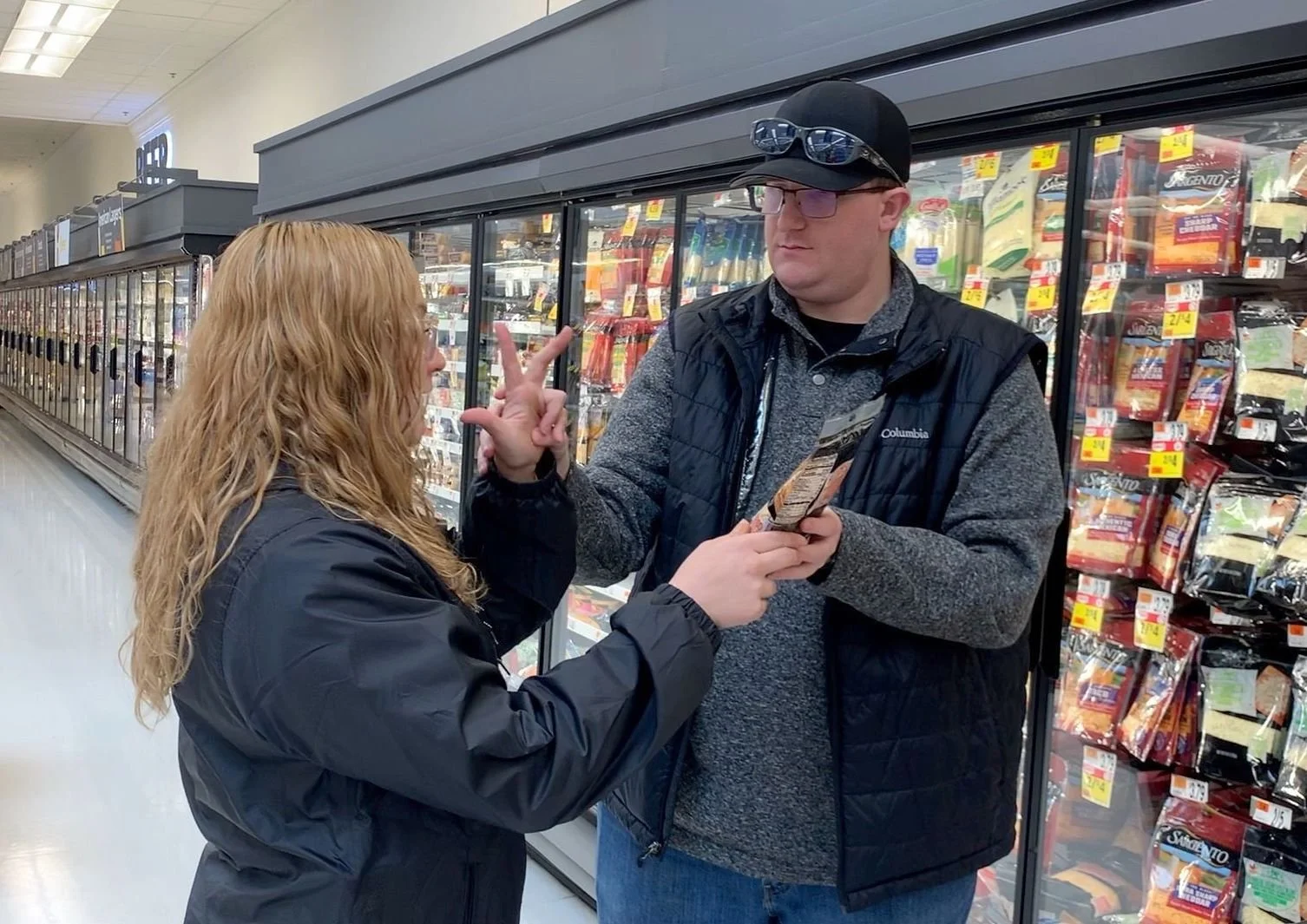
Image: A woman with long blonde hair faces a man, her SSP, who is wearing a black cap and glasses in the refrigerated aisle of a grocery store. She is signing with one hand while her other hand holds a packaged food item the man is also touching, suggesting she is communicating information about the product to him. Refrigerated dairy and deli cases line the background. Image from hellenkeller.org
That choice is this: without SSPs, many people with dual sensory loss end up in nursing homes and long-term care facilities. Not because they need the level of medical care those facilities provide. Not because it is what they want. But because the community infrastructure is not there to support them living independently.
What results is a lack of accessibility to services; services for deaf or blind people, but not Deafblind; very long waitlists, service deserts, a scarcity of SSPs due to low pay and low funding, and more.
This is not only an independent living issue. It is a civil rights issue. And it is one we believe Colorado must acknowledge and address.
What Dual Sensory Loss Means for Independent Living
Before we go further, it helps to understand how many people we are talking about. The numbers are harder to pin down than they should be, which is itself a problem. The U.S. Census Bureau does not currently cross-reference hearing and vision loss data to produce a count of people with both impairments. This is a gap that the bipartisan Deafblind DATA Act, introduced in Congress in 2024, sought to address. Estimates range widely as a result: the National Center on DeafBlindness estimates approximately 10,000 children and 40,000 adults are Deafblind in the United States using a stricter definition, while the Helen Keller National Center, drawing on 2022 American Community Survey data, estimates 2.47 million Americans live with combined hearing and vision loss when self-reported difficulty with both senses is counted.
In Colorado, nearly 1,200 people identify as deaf-blind, and just over 130 children and youth under the age of 21 have been formally identified as having combined vision and hearing loss through the state's education system.
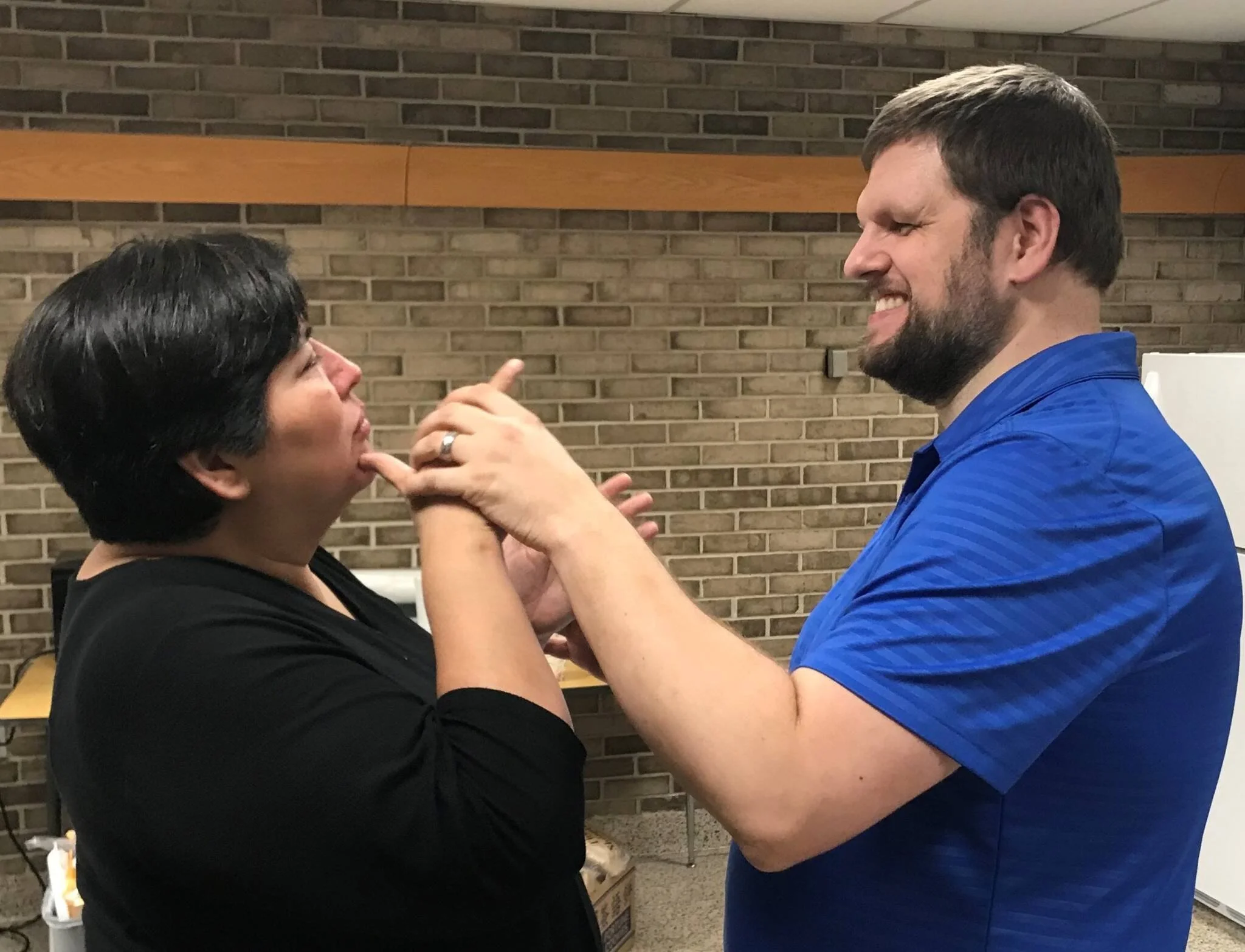
Image: A woman and a man face each other, hands intertwined near face level as they communicate using tactile sign language. The man is smiling broadly. A brick wall is visible in the background. Image from hellenkeller.org
These numbers tell us two things. First, this community is larger than most people realize. Second, we are almost certainly undercounting, because without the right data infrastructure, people with dual sensory loss remain invisible to the systems that are supposed to serve them.
People with dual sensory loss experience a unique set of barriers that are compounded when both senses are affected. Communication, navigation, access to information, and participation in everyday community life all require support that goes beyond what either blindness services or deafness services alone can provide.
SSPs are the trained professionals who provide that support. They are not caretakers or aides. They do not make decisions for the people they work with. What they do is provide access through services such as describing the physical environment, facilitating communication, providing sighted guidance, and relaying visual and auditory information, allowing a person with dual sensory loss to make their own choices and move through the world with autonomy and dignity.
With an SSP, a person with dual sensory loss can go to the grocery store, attend a doctor's appointment, participate in a community meeting, or visit a friend. Without an SSP, those activities become inaccessible, not because of the person's disability, but because the support structure is not there. The barrier is not the person. The barrier is the lack of services.
The Institutionalization Pipeline
Here is the reality that does not get discussed enough: when people with dual sensory loss cannot access SSP services, institutionalization often follows. Not immediately, and not for everyone, but for many people, the absence of community-based support is a slow erosion of independence that ends in a nursing home or long-term care facility.
This is not inevitable. It is the result of a funding system that has not kept pace with need. In Colorado, as we reported last year, the Colorado Commission for the Deaf, Hard of Hearing, and DeafBlind (CCDHHDB), the state's primary funder of SSP services, ran out of funding in 2023. Services were reinstated through a temporary partnership with the Colorado Cross-Disability Coalition (CCDC), and the program has since stabilized at 24 hours of SSP service per month per person. That is progress. But it is still constrained by financial and personnel resources, and a significant waitlist for services is believed to still exist in Colorado. (Note: We were unable to confirm the current waitlist numbers before publication and encourage readers to contact CCDHHDB directly at Katie.Cue@state.co.us for the most current information.)
Twenty-four hours per month is roughly six hours per week. For context, that is enough time for a few essential errands. It is not enough time to fully participate in community life, pursue employment, or live with the kind of independence the Americans with Disabilities Act was designed to protect.
The 1999 Supreme Court Olmstead decision established that unnecessarily institutionalizing people with disabilities violates the ADA. States have a legal obligation to provide community-based services when those services are appropriate. SSP funding is not a discretionary budget line. It is part of Colorado's obligation to its residents with disabilities.
And the fiscal argument is just as clear. Nursing home care costs a national median of roughly $10,646 per month for a private room (this is a 2024 national median). SSP services cost a fraction of that. Investing in SSP access is not just the right thing to do; it is the cost-effective thing to do for the state of Colorado.
What Is Being Built — Reasons for Optimism
We do not write this article to paint a picture of a crisis without hope. There is real, meaningful work happening, and we want to shine a light on it.
In Colorado, a new Deafblind-led organization called the DeafBlind Action Team (DBAT) has emerged, supported by CCDC, to organize within the community, raise awareness of available resources, including Medicaid waivers, and increase the participation of people with dual sensory loss in government and civic life. DBAT represents something important: the Deafblind community advocating for itself, building power from within.
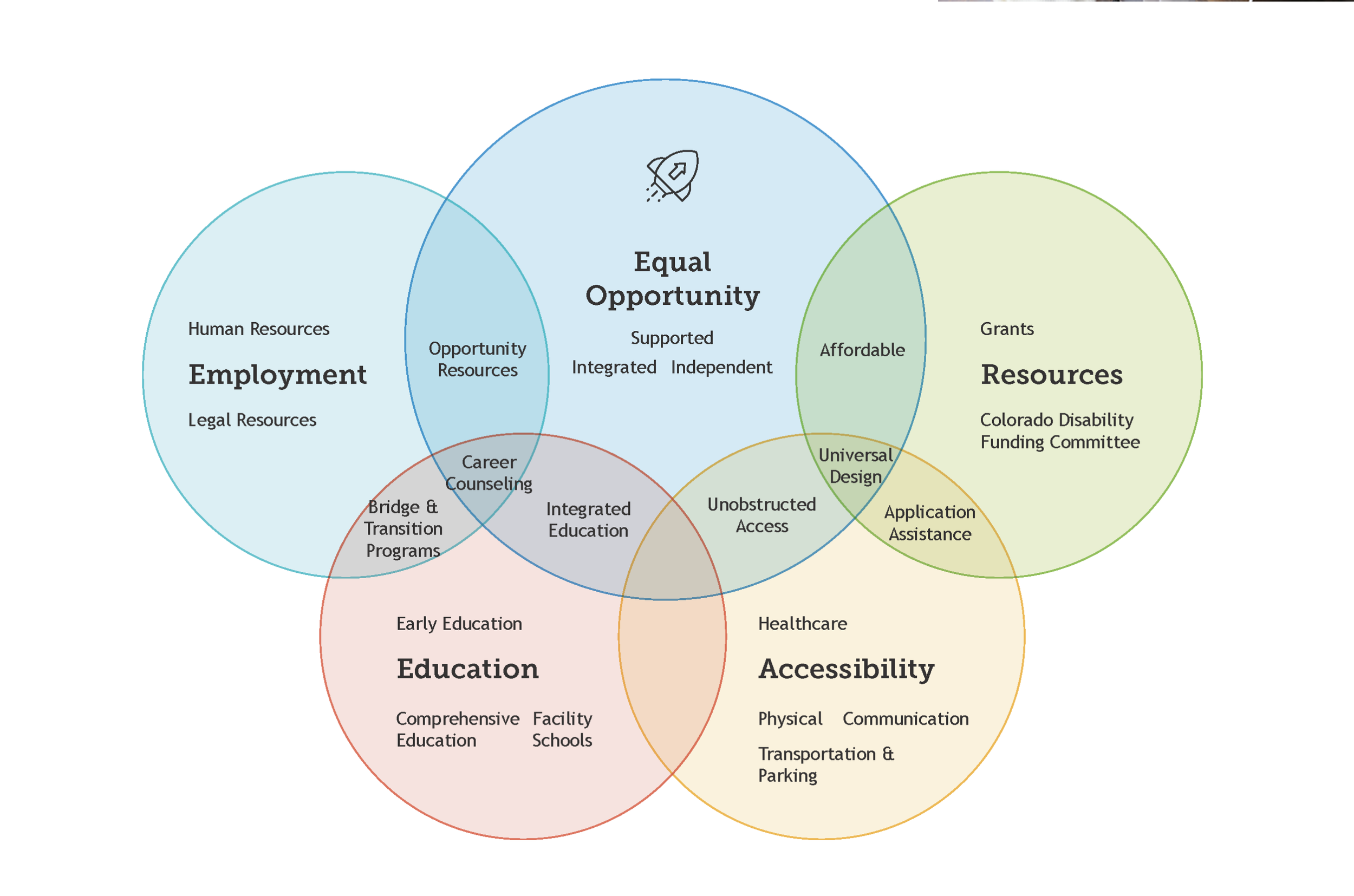
Image: A diagram representing all opportunities to explore through CDOO
The Colorado Disability Opportunity Office (CDOO), working alongside CCDC and the Colorado Health Institute, is conducting what may be the nation's first comprehensive statewide disability needs assessment. The data this assessment produces could be exactly what advocates need to make the case for permanent, adequate SSP funding to the Colorado General Assembly.
At the national level, the Helen Keller National Center (HKNC) continues to be the leading resource for SSP training, program development, and workforce support. HKNC maintains an SSP Toolkit to help states build and formalize their programs, and offers professional training on everything from community-based living options to communication strategies for people with dual sensory loss. States like Pennsylvania and Arizona have used models like this to build structured, statewide SSP programs with clear training pathways, defined eligibility, and consistent service hours. Colorado has the opportunity to do the same.
A New Threat at the Federal Level
There is also a new challenge we need to name directly. In September 2025, the U.S. Department of Education terminated IDEA Part D grants for Deafblind education programs in eight states — Washington, Oregon, Wisconsin, and a consortium of New England states. These grants funded the specialized training, family support, assistive technology, and professional development that make it possible for people with dual sensory loss to be educated, supported, and ultimately employed in their communities.
These cuts came with seven days' notice. In Oregon, programs serving over 100 students were eliminated mid-cycle. In Wisconsin, 170 students lost access to a program that had been funded through 2028. The stated reason was that language in grant applications conflicted with the administration's priorities around diversity, equity, and inclusion, including words like "transition" (as in, transitioning from childhood to adulthood) and "privilege" (used in a parent's positive review of staff).
Colorado's own Deafblind education programs were not among those cut. But the precedent is concerning. The University of Northern Colorado's interpreter training grant was among those terminated nationally, which was a direct blow to the pipeline of trained professionals that SSP programs depend on.
When the federal floor erodes, state investment matters more. This is exactly the moment for Colorado to build a stronger, more permanent foundation for SSP services, not to rely on federal discretionary funding that can disappear overnight.
What We Can Do Together
Here at CPWD, we believe that people with dual sensory loss belong in their communities. They deserve to choose where they live, how they spend their time, and who they spend it with, the same as everyone else. SSPs are the infrastructure that makes that possible.
There are concrete steps all of us can take to support this work.
Contact your Colorado state legislators. Ask them to support permanent, dedicated funding for SSP services through the CCDHHDB. The case for this funding is strong; morally, legally, and financially. What is missing is political will.
Support the Colorado Cross-Disability Coalition (CCDC) and the DeafBlind Action Team (DBAT). These organizations are doing the organizing and advocacy that creates change. You can find CCDC at ccdconline.org.
Consider becoming an SSP. Colorado currently trains SSPs through the CCDHHDB. If you are a fluent signer, an orientation and mobility specialist, or simply someone committed to this work, there is a path in. Contact the CCDHHDB DeafBlind Services Coordinator to learn more.
Share this article. The more people who understand the connection between SSP access and independent living, the stronger the case becomes for the sustained investment this community deserves.
Independent living is not a privilege. It is a right. And for people with dual sensory loss, Support Service Providers are how that right becomes real.
If you or someone you know needs assistance, resources, or referrals related to independent living services in Colorado, please reach out to CPWD at info@cpwd.org or call (303) 442-8662.