

Accessibility Is a Global Conversation, and It's Moving Fast
When Mind Prawatsrichai visited the Center for People with Disabilities from Bangkok, she came as a working professional with a specific purpose. Mind is a television host who has built her career in Thailand doing something that matters: appearing on screen to share the lives and stories of people with disabilities in ways that are honest, human, and grounded in dignity. She was here to observe, to learn, and to bring ideas back to her community. What she found at CPWD was a consumer-directed model of services, peer support rooted in lived experience, and an organizational philosophy that treats people with disabilities as decision-makers rather than recipients. All of it added to a body of knowledge she is actively using to shape her work at home.
Mind's visit is a useful entry point into a much larger conversation. The movement to build accessible, inclusive communities is not a uniquely American project or a Western export. It is a global effort. It is uneven, evolving, and powered by advocates in every country who are asking the same fundamental questions in different languages and cultural contexts. What does it mean to design a world that works for everyone? Who gets to define accessibility? And what can we learn from each other?
Those questions are more alive right now than they have been in decades.
A Movement At A Turning Point
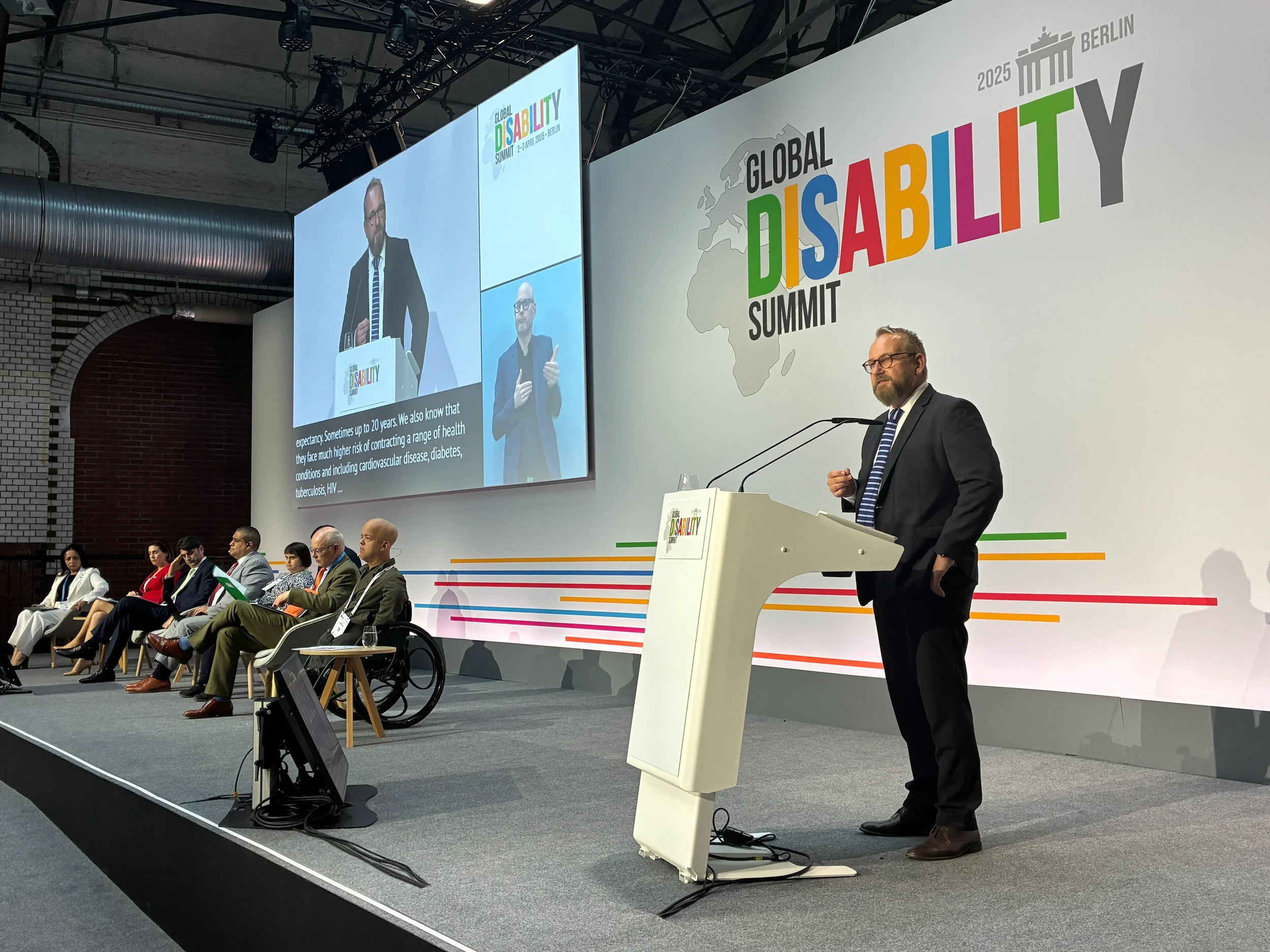
Image: Darryl Barrett, technical lead of the WHO Disability Program, speaks during the Global Disability Summit.
In April 2025, the third Global Disability Summit brought together governments, disability-led organizations, researchers, and advocates from nearly 100 countries in Berlin. The Global Disability Inclusion Report, developed for the Summit, provides an overview of how the profound changes shaping our world affect the diversity of persons with disabilities and the pathways to address these changes and drive inclusion across all aspects of life. The report reflects what advocates on the ground already know: the legal frameworks have expanded significantly over the past two decades, the political commitments have multiplied, and the practical gaps between what laws say and what people experience remain stubborn and real.
That gap is not a reason for pessimism; instead, it can be seen as an agenda for advocacy work. And the advocates, technologists, policymakers, and community members working to close it are generating ideas and models that are genuinely worth paying attention to, wherever they emerge.
Consider what is happening right now in a handful of different places:
GERMANY AND THE EUROPEAN ACCESSIBILITY ACT
Europe has been moving toward a unified accessibility standard across member nations, and 2025 marked a significant milestone. The European Accessibility Act, which took effect in 2025, aims to enforce digital accessibility standards for both public and private websites across member states.
Germany has paired this with financial incentives for companies investing in accessibility infrastructure and tools like wheelmap.org, which maps the accessibility of facilities and helps people navigate their environments with real, crowdsourced information.
The European approach is significant because it addresses digital accessibility as a matter of law rather than best practice. As more of daily life, banking, healthcare, employment, and civic participation moves online, the accessibility of digital environments becomes as consequential as the accessibility of physical ones. Treating it as a legal requirement, not a courtesy, changes the stakes for organizations that might otherwise deprioritize it. This is a tremendous standard of accessibility worldwide.
JAPAN AND REAL-TIME COMMUNICATION ACCESS
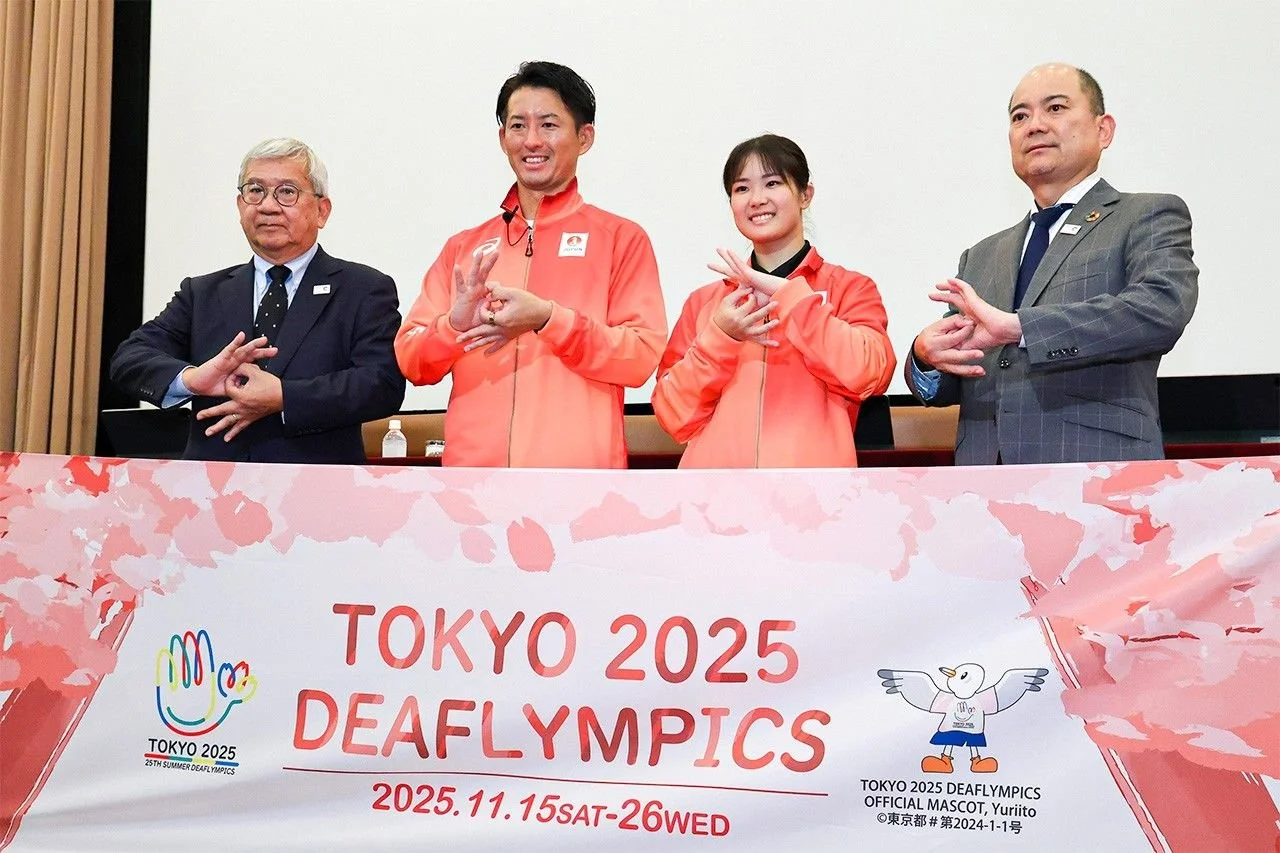
Image: Posing with a gesture used in sign language at an October 2025 press conference for the Tokyo Deaflympics are, from left, Team Japan leader Ōta Yōsuke, men’s soccer team captain and flag bearer Matsumoto Takumi, women’s karate athlete Ogura Ryō, and Ishibashi Daigo, president of the Japanese Federation of the Deaf. (© Jiji)
Japan has been investing in technological solutions for communication access, particularly for deaf and hard-of-hearing communities. The Tokyo 2025 Deaflympics served as a catalyst for a wave of practical innovation. In preparation for the games, Tokyo's metropolitan government developed video apps for sign language interpretation, installed transparent displays that convey text via touch screens, and deployed flash doorbells that use light in place of sound, all under its "Tokyo for Everyone" initiative.
SoftBank partnered with the games to provide accessibility technology specifically for deaf and hard-of-hearing attendees. The Japanese Federation of the Deaf trained 109 International Sign interpreters and 142 additional interpreters in advance of the event, while Japan enacted a new law to promote the use of sign language.
Japan's investment in this work is tied to its demographics. People 65 and older now account for a record 29.4 percent of Japan's total population, the highest proportion of any country in the world. When nearly a third of your society is older, and many are acquiring disabilities, accessibility stops being a niche concern and becomes a mainstream design imperative. As population aging has progressed in Japan, design concepts have gradually shifted from special solutions for special people to universal solutions, with everything from housing to public transport to everyday products being reimagined with the widest possible range of users in mind.
Universal design has found fertile ground in Japan precisely because its benefits extend so broadly. Curb cuts serve wheelchair users and parents with strollers. Captioning helps people in noisy environments. What begins as accommodation for one group becomes infrastructure for everyone.
THAILAND AND THE POWER OF REPRESENTATION
Thailand's disability rights landscape is in active development. Work is being done on the national level to ensure inclusive digital access, as more than two million people with disabilities in Thailand continue to face online inequality that limits access to essential services in health, finance, and education. Government, academic, and private-sector stakeholders are working together to implement web accessibility standards nationwide, recognizing that digital inclusion is not a technical upgrade but a civil rights issue.
What makes Thailand's story particularly compelling right now is the role that advocates like Mind are playing in shifting cultural attitudes alongside policy change. Laws can mandate accessible design. They cannot mandate the cultural shift that makes inclusion feel normal rather than exceptional. That shift requires visibility: people with disabilities showing up in public life, in media, in leadership, in ways that expand what their communities believe is possible. Mind's television work is part of that effort. It operates on the understanding that representation is infrastructure too.
INDIA AND COMMUNITY-BASED INNOVATION
India's disability rights movement has been building momentum through community organizing, legal advocacy, and increasingly, technology. At the International Purple Fest 2025, a South-South workshop brought together organizations of persons with disabilities and UN agencies from Bhutan, the Maldives, Thailand, and India, focusing on practical models including community early-warning systems, accessible evacuation protocols, and inclusive school preparedness. The exchange of practical knowledge between countries at similar stages of development, rather than always from wealthier nations to less wealthy ones, is producing contextually grounded solutions that are more likely to stick by empowering the communities to find solutions that work for their unique needs.
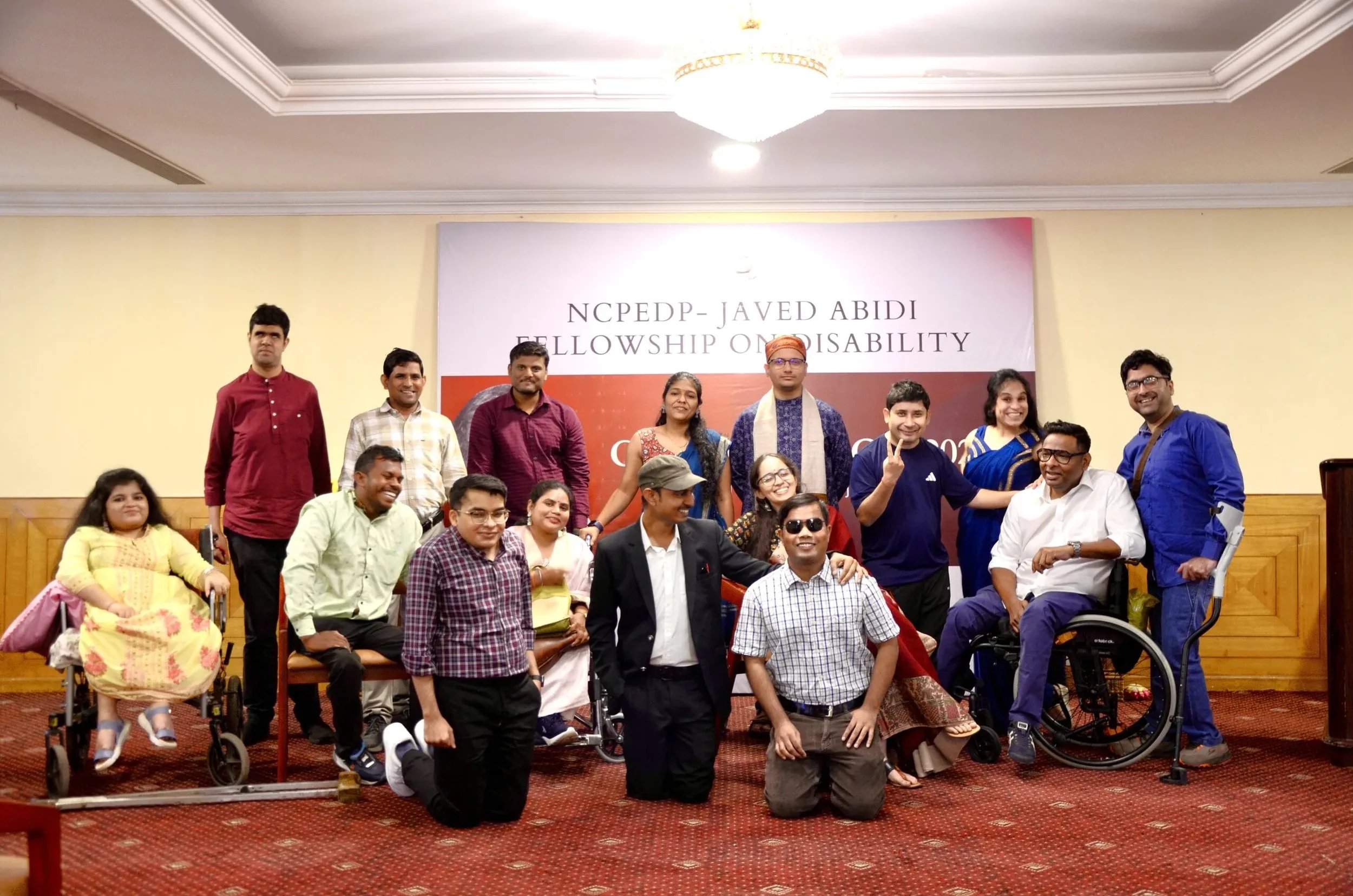
Image: Winners of the NCPEDP-Javed Abidi Fellowship on Disability are pictured together in front of a banner. Learn more about the Fellowship here.
India is also producing disability-led advocacy organizations that are reshaping national policy from the inside, building the kind of political infrastructure that makes sustained change possible. In 2024, the Supreme Court of India delivered a landmark accessibility ruling that transformed accessibility from an aspirational goal into a mandatory legal standard, reflecting decades of sustained advocacy work by organizations of persons with disabilities pushing from within the system.
Technology As Equalizer, And The Work That Remains
Across all of these contexts, technology is playing an increasingly significant role in expanding access. From accessible learning tools to assistive devices and inclusive digital platforms, technology is playing an integral role in creating inclusive environments. Google's global effort focuses on building accessibility into AI, software, hardware, and everyday tools. Be My Eyes uses AI and real people to support blind and low-vision users in daily tasks.
These tools matter. Assistive technology has transformed daily life for millions of people with disabilities, and the pace of innovation is accelerating. AI-powered captioning, screen reader improvements, adaptive controllers, apps that provide real-time navigation assistance for people with visual impairments: the list of what is now possible that was not possible a decade ago is genuinely remarkable. To learn more about other accessible technologies, check out this previous article.
But technology is not a substitute for structural change. An app does not fix an inaccessible building. Real-time captioning does not replace an employer who refuses to accommodate. Digital accessibility tools are most powerful when they operate within systems, legal, cultural, and organizational, that already value inclusion. Technology advances fastest when advocacy catches up to it.
What the IL Movement Offers The World
The Independent Living philosophy that guides CPWD's work has something specific to contribute to this global conversation. The core idea is that people with disabilities are the experts on their own lives, that peer support is uniquely powerful, that consumer direction is not just a service delivery model but a statement about who gets to make decisions. This is not universally understood or practiced, even in countries with strong legal frameworks.
The UNDP's disability inclusive development strategy in Thailand adopts a rights-based approach centered on empowerment, inclusion, equity, and human development, language that maps closely onto what the Independent Living movement has argued for fifty years. But legal language and lived practice are different things.
Countries that are building their disability rights infrastructure right now can learn from the IL movement's decades of experience in making rights real at the community level, in the room, between people, through relationships and trust, and the specific knowledge that only comes from having navigated a system yourself.
That is what Mind was here to see. Not a finished product. A working model, built over time, full of lessons earned.
Image: Logo for the International Day of Persons with Disabilities. On the left is a graphic of colorful line arms creating a circle, with a blue circle in the middle.
The 2025 theme for the International Day of Persons with Disabilities was "Fostering disability-inclusive societies for advancing social progress." That framing matters for social change. Disability inclusion is not a standalone issue sitting at the margins of a broader social agenda. It is embedded in questions about who gets to participate in economic life, who has access to education and healthcare, who can move through public space, and who gets heard in policy decisions.
When those questions are answered well, when access is designed in from the start, when people with disabilities are at the table where decisions are made, when cultural attitudes catch up to legal commitments, the benefits extend outward. Curb cuts help parents with strollers. Captioning helps people watching in noisy environments. Accessible digital design helps older adults. Universal design, by definition, serves everyone.
The global conversation about accessibility is accelerating. Countries are learning from each other. Advocates are sharing models across borders. Technology is opening new possibilities. Legal frameworks are expanding. And organizations like CPWD, grounded in community, rooted in lived experience, committed to the idea that every person's autonomy is worth protecting, have a role to play not just locally but in that larger conversation.
Mind knew that when she came to visit. She comes from a tradition of advocates who understand that the work is bigger than any one country, that ideas travel, and that showing up, on screen, in person, across the world, is part of how things change.