

Aging, Disability, and Ageism: Our Rights as We Grow Older
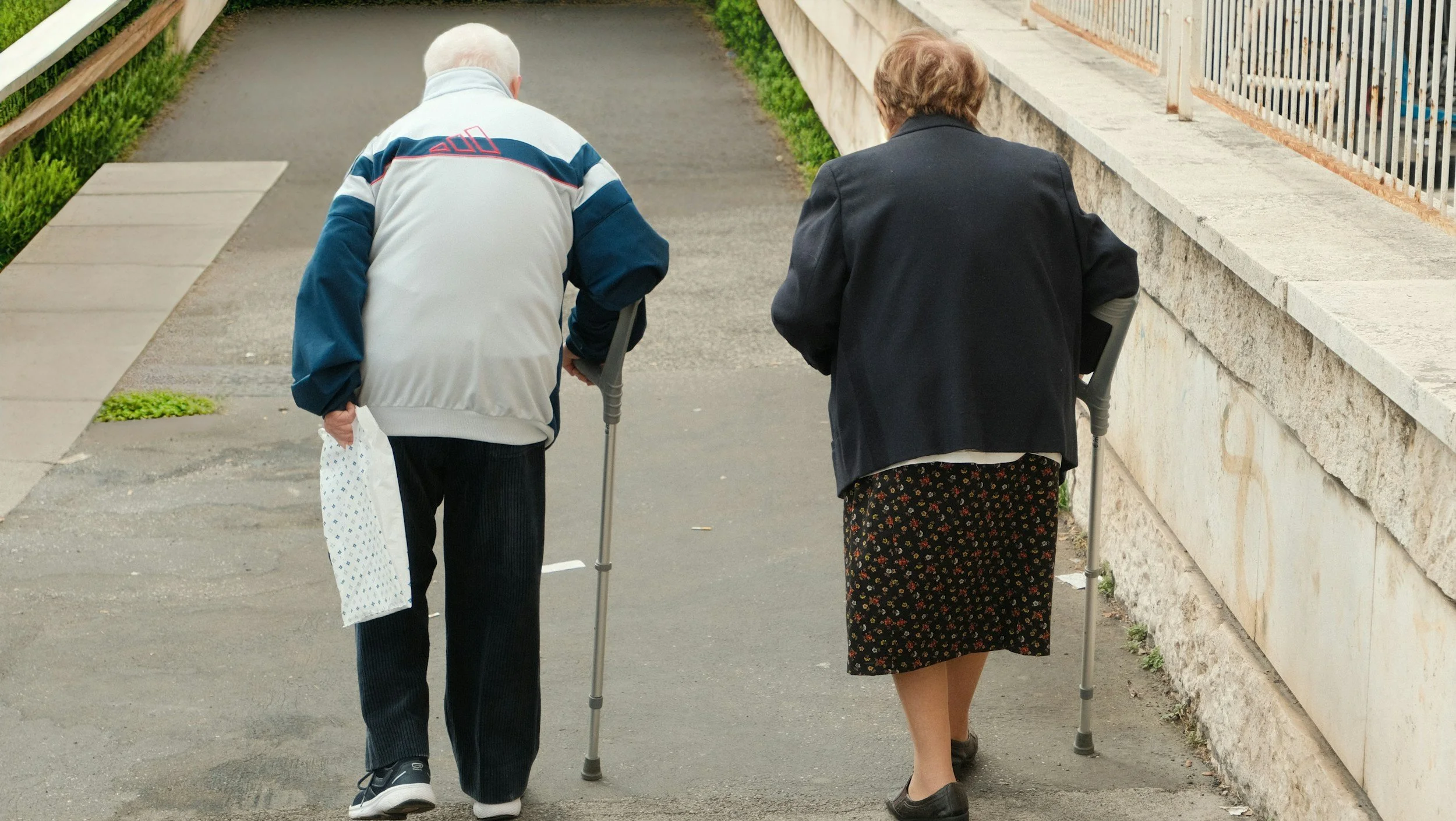
Image: An elderly man and woman walk side by side, each using a crutch.
Some of us have lifelong disabilities, some of us acquired our disabilities along the way, and most of us, including people who do not have a disability today, will likely acquire one as we age. Changes in mobility, vision, hearing, and memory are common as the years add up. These changes can be a challenge for people who are newer to disability, and also for those of us who have lived independently with a disability for decades. Social attitudes about ageism, barriers to health care and supportive services, and other obstacles can make the change even harder.
In this article, we look at how common disability is among older adults, how ageism shows up in health care, housing, work, and public life, and what rights protect us at every age. We close with practical steps and where to turn for support. At CPWD, our mission is to assist people with any disability in overcoming barriers to independent living, and that includes every one of us who is growing older.
Aging Brings Disability, Even When We Do Not Call It That
Aging into disability is one of the most common experiences we share. For the first time in the nation's history, the Census Bureau projects that by 2034, adults 65 and older will outnumber children. Whether we have lived with a disability for decades or are noticing changes for the first time, we are in good company.
According to the Centers for Disease Control and Prevention (CDC), about 2 in 5 adults age 65 and older have a disability. The most common is mobility, meaning serious difficulty walking or climbing stairs, which affects about 27 percent of older adults. Hearing loss follows at about 15 percent, and visual impairment affects about 7 percent.
Many people do not use the word disability. In February 2025, the University of Michigan's National Poll on Healthy Aging surveyed more than 3,800 adults aged 50 and older. Only 19 percent identified as a person with a disability, even though far more described limitations in hearing, seeing, walking, thinking, or self-care. Michelle Meade, founding director of the University of Michigan Center for Disability Health and Wellness, explained that many older adults see these changes as a natural part of aging and do not want the stigma that comes with the word "disability."
So, why does the word matter? The rights we hold under the Americans with Disabilities Act (ADA) apply to a person with a disability at any age. When we recognize a change as a disability, we can ask for the tools and accommodations the law already guarantees, such as large-print materials, amplification devices, accessible entrances, and more time at an appointment. Research cited in the same coverage found that people who identify with the disability community report higher self-esteem and less depression and anxiety than those who do not.
A Community With a History
Whether we have been part of the disability community for decades or are claiming our place in it later in life, we share a movement that worked hard to lay the foundations for independent living over the decades, and that is something to hold with pride. In April 1977, activists with disabilities occupied the federal building in San Francisco for 26 days and refused to leave until Section 504 of the Rehabilitation Act was signed, the first federal law stating that people with disabilities cannot be shut out of programs that receive public money.
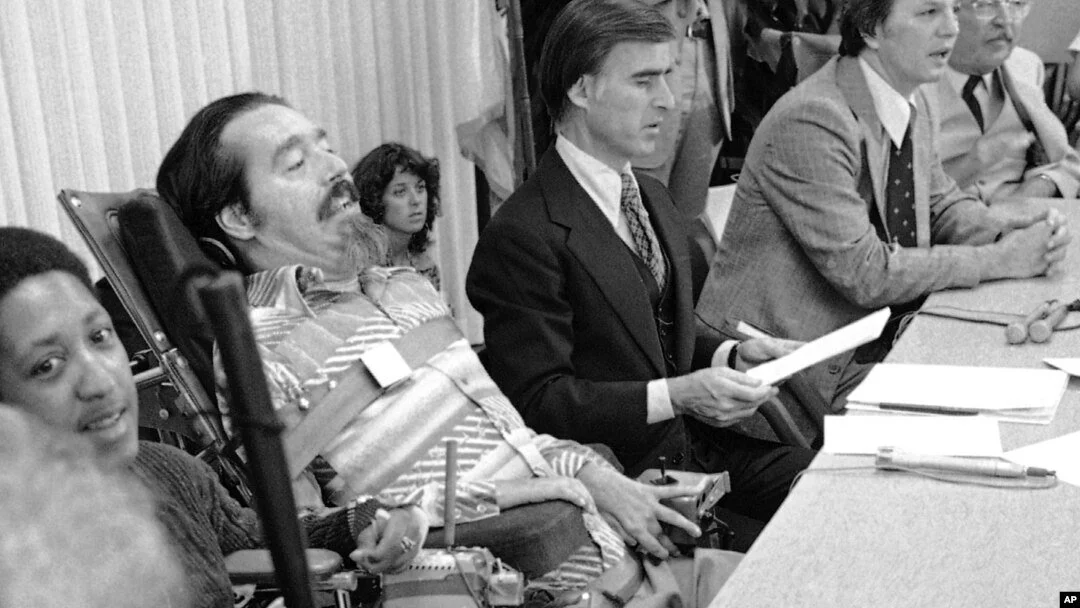
Image: Ed Roberts testifies before Congress.
That generation built the world we all move through now: the curb cut at the corner, the captions on the screen, the ramp beside the stairs, and the independent living movement itself, which an activist named Ed Roberts and his peers created on a simple principle: that people with disabilities have the right to live in our own homes and make our own decisions. CPWD is one of the centers that the movement built. As we grow older, all of it is ours: the rights, the tools, the people who stand alongside us, and the torch to carry forward for the next generation.
What Ageism Looks Like
In 2021, the World Health Organization (WHO) released its first Global Report on Ageism. Based on a survey of more than 83,000 people in 57 countries, it found that one in two people (50% of people) hold moderately or highly ageist attitudes toward older people. The WHO defines ageism as using age to sort and divide people in ways that lead to harm, disadvantage, and injustice.

Image: An elderly woman speaks with a doctor.
When ageism meets disability, it is often cloaked in the language of concern. Here are some examples:
A doctor treats a new symptom as "just getting older" and does not test, treat, or refer.
A family or a hospital discharge planner assumes that a person who uses a walker or has low vision now needs assisted living, before anyone asks what supports would enable that person to remain in their own home.
An employer passes over an experienced worker for training or promotion because of age.
Event organizers and civic groups stop inviting older neighbors to serve, speak, or lead.
The WHO report links ageism to poorer physical and mental health, greater social isolation, and financial insecurity. The same report recommends three responses: policies and laws that address ageism, education that challenges stereotypes, and programs that bring generations together. Each of those is work our community already knows how to do.
Living at Home Is a Right
In 1999, the U.S. Supreme Court decided Olmstead v. L.C., a case brought by two women with disabilities in Georgia, Lois Curtis and Elaine Wilson, who had been kept in a state institution after their own treatment teams said they could live in the community. The Court ruled that unjustified segregation of people with disabilities is discrimination under the ADA. Basically, this means that when a person can live in the community with the right supports and wants to, the state has a duty to make that possible.
That ruling applies at every age. Needing help with bathing, medications, or getting around does not by itself mean a person belongs in a facility. Home modifications, personal care, assistive technology, accessible transportation, and peer support make it possible for many of us to stay in our own homes and neighborhoods, near the people and places we know. When a move to assisted living is the right choice, it should be the person's own choice, made after they have been fully informed about options.
Our Voices in Civic Life and at Work
We bring decades of experience to our communities, and the law protects our place in public life and in the workplace.
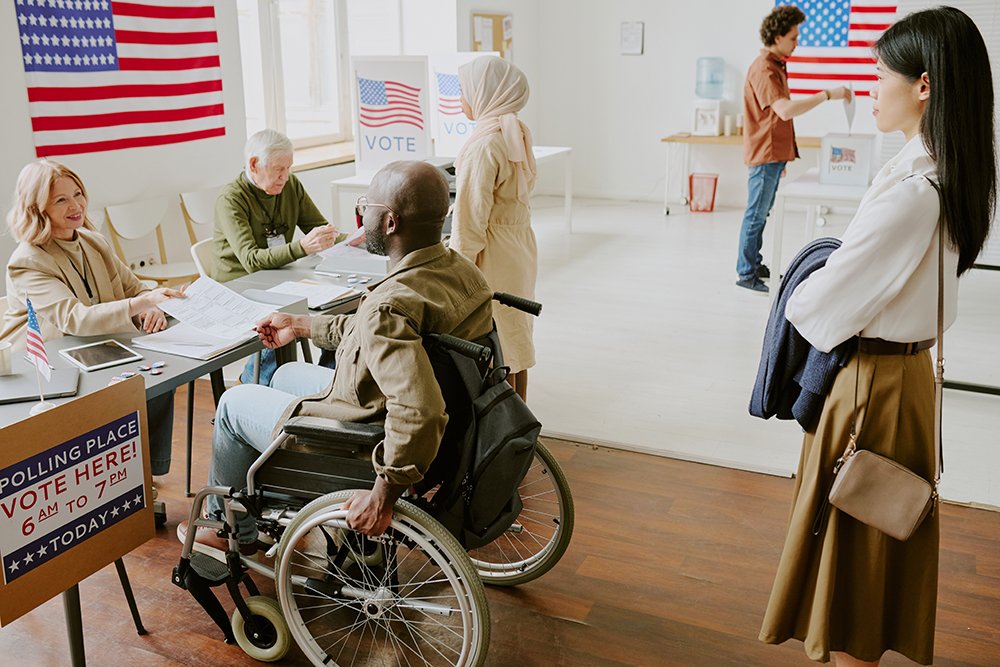
Image: A man who is a wheelchair user registers to vote.
Voting. Colorado mails a ballot to every active registered voter, and every county offers accessible voting options, including accessible voting machines at voting centers. A voter who needs help marking a ballot may bring a person of their choice to assist, as long as that person is not the voter's employer or union representative.
Boards and public meetings. City councils, transit boards, and planning commissions make decisions about sidewalks, bus routes, and housing that shape whether we can age in place. Under the ADA, public meetings must be accessible, and we can ask for accommodations such as captioning, assistive listening devices, or remote participation.
Work. The Age Discrimination in Employment Act of 1967 protects workers age 40 and older from discrimination in hiring, firing, pay, and promotion. The ADA protects workers with disabilities at any age and requires employers with 15 or more employees to provide reasonable accommodations, such as a screen reader, a modified schedule, or a workstation that reduces standing. A worker who is losing vision or hearing late in a career has the same right to accommodations as anyone else.
What You Can Do Next
Growing older with a disability is part of a long tradition of people with disabilities who have adapted, organized, and insisted on living full lives. Here are some ways we can put that into practice:
Ask for what we need. Request an accommodation from our doctor's office, our employer, or our landlord. A short written request that names the barrier and the change we need is a strong start.
Tell us about a barrier. If a sidewalk, a bus stop, a clinic, or a polling place is not working for you, let CPWD know. Systems advocacy starts when someone names the problem.
Show up where decisions are made. City planning meetings, transit boards, and public comment periods shape whether our neighborhoods work for every age. Make the time and effort to bring your voice and lived experience to decision-makers.
Offer what we know. Peer support from someone who has already learned to live with low vision,a mobility device, or another disability can make all the difference for a neighbor, or stranger, who is just beginning their independent living journey.
Stay informed. Sign up for advocacy updates on the CPWD website, so we hear about bills, hearings, and comment periods while there is still time to act.
We have rights at every age. We have options. And none of us has to figure it out on our own. Reach CPWD at info@cpwd.org or (303) 442-8662 to connect with our team.