

American Sign Language: A History of Learning and Growth

Image: A woman demonstrates an ASL sign. She is pictured from the shoulders down.
September 23 is the International Day of Sign Languages. This article covers what American Sign Language actually is, how the Deaf community built and protected it over two centuries, how many people it touches today, the legal floor for accessible communication, and where both ASL and communication access are still growing, including right here in Colorado.
What American Sign Language Is
American Sign Language, or ASL, is not English translated onto the hands. It is a complete language with its own grammar, syntax, and word order, and for a large part of the Deaf community, it is a first language, the one people think and dream in. In 1960, linguist William Stokoe, a professor at Gallaudet University, published "Sign Language Structure: An Outline of the Visual Communication Systems of the American Deaf," the first academic work to treat ASL as a genuine language with its own syntax and morphology. Stokoe's research changed the academic record to match what the Deaf community had always known: ASL is a complex, independent language as functional as any spoken one. He later co-authored the first linguistic dictionary of ASL in 1965 and is widely credited as the founder of sign language linguistics.
Sign language is not universal, and it is not one thing. Researchers estimate there are around 300 sign languages in use around the world today, and the true number keeps growing as new ones are documented. ASL is not related to British Sign Language, even though the United States and the United Kingdom share a spoken language. ASL descends from Old French Sign Language, while British Sign Language sits in an entirely separate family that also produced Australian and New Zealand Sign Language. Each of these languages developed the way any language does, inside a community that used it and passed it on.
Before ASL: Deaf People Have Always Made Language
Long before ASL had a name, Deaf people were already communicating in full languages with complex grammar of their own making. Deaf children raised without access to any sign language do not go without language. Researchers call what they build home sign, and studies of it show consistent word order, grammatical markers for negation and questions, and structures that hold up across cultures as different as Turkey, Brazil, and the United States. That capacity is the raw material every sign language grows from. When one Deaf person's invented signs meet another's, and then another's, those individual systems can converge into a shared language a whole community passes down, what linguists call a village sign language.
The clearest American example predates ASL and sits directly inside its own history. Martha's Vineyard Sign Language grew out of a hereditary form of deafness carried by descendants of English settlers on the island, and by 1854, when the island's deaf population peaked, the town of Chilmark averaged one deaf resident in every 25, with one small district, Squibnocket, running as high as one in four. The language was in use from the early 1700s until 1952, and hearing islanders learned to sign as children too, so thoroughly that farmers signed to each other across open fields, fishermen signed boat to boat, and churchgoers signed through sermons. Deafness was not a barrier to daily life there. It was simply one more way people talked to each other.
Paris had its own signing Deaf community well before anyone built a school for it. When Charles-Michel de l'Épée founded the first free public school for deaf students there in 1760, he did not invent sign language, whatever the popular version of that story says. He learned the sign language Deaf Parisians already used among themselves, now known as Old French Sign Language, and built his teaching method on it. Laurent Clerc, educated at that same school, carried that language's lineage to Hartford in 1817, where it became one of the roots of ASL.
None of this waited on any single institution or invention. Deaf people have always made language, with or without a school, a linguist, or a name for what they were doing.
How ASL Took Root
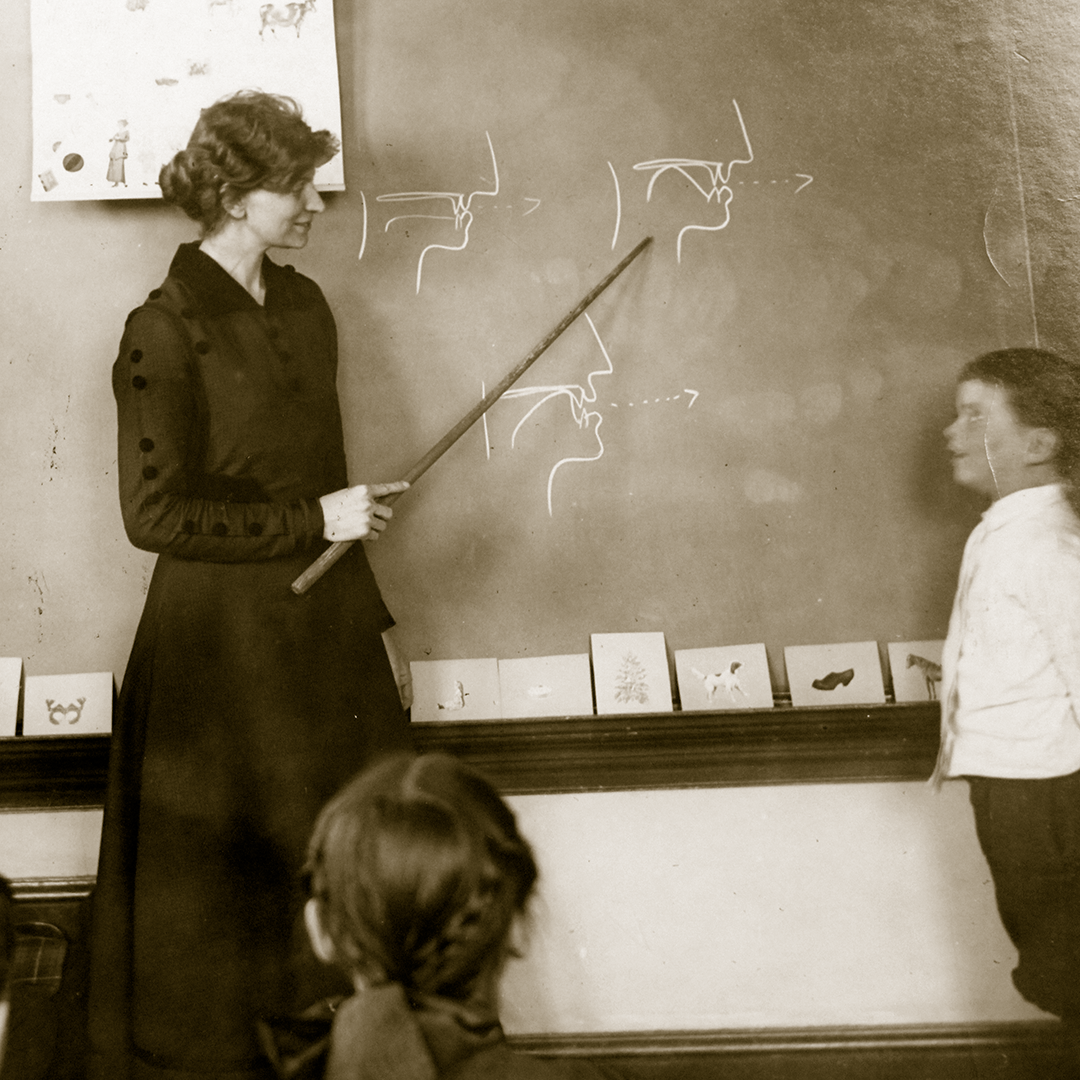
Image: A teacher instructs a student at the American School for the Deaf. Photo from the American School for the Deaf.
ASL's American story starts on April 15, 1817, in Hartford, Connecticut, with the founding of what is now the American School for the Deaf. The school exists because of Alice Cogswell, a girl deafened by illness in childhood, whose father recruited a young divinity graduate named Thomas Hopkins Gallaudet to find her an education. Gallaudet traveled to Europe, and in Paris he recruited Laurent Clerc, a Deaf teacher from the renowned school for the deaf there. Clerc's French Sign Language, brought to Hartford and blended with the sign systems already used within American Deaf communities, became the foundation ASL grew from. The school opened in 1817 with seven students, Alice Cogswell among them.
A Community That Organized to Protect Its Own Language
Deaf Americans have never been passive about their own language. On August 25, 1880, Deaf leaders held the first national convention of Deaf-Mutes in Cincinnati, the founding gathering of what became the National Association of the Deaf, organized explicitly to deliberate on the needs of the Deaf community as a group with its own interests to represent. That same year, a conference of hearing educators in Milan, Italy, known as the Milan Congress, voted to favor speech-based instruction over sign language in deaf schools. The Deaf community's own organization responded by doing exactly what an advocacy group does: it kept organizing. NAD passed a resolution opposing pure oralism in 1893; its president called for the preservation of sign language in 1904; it formed a committee in 1910 to film and preserve ASL on early motion picture technology specifically so the language would survive, and its 1920 convention resolved that anyone attempting to take sign language from Deaf people was working against their happiness and interest. That record of continuous, organized advocacy is what carried ASL through decades when the education establishment favored something else.
The rest of the field eventually caught up to what Deaf Americans had been saying about their own language all along. In July 2010, the International Congress on Education of the Deaf formally rejected the 1880 Milan resolutions, and in 2025, the same body fully and unequivocally renounced them, naming the harm caused by decades of excluding sign language from classrooms. That is not a story of a community waiting to be rescued. It is the record of a community that organized in 1880 and kept organizing until the record was set straight.
Deaf President Now: Building on a Century of Organizing
That century of organizing culminated in March 1988 at Gallaudet University, when the Board of Trustees passed over two Deaf finalists for university president and chose the only hearing candidate instead. Students shut the campus down for eight days in what became known as Deaf President Now. Their four demands, that a Deaf president be named, that the Board chair resign, that at least 51 percent of the board members are deaf, and that no protester face reprisals, were all met by the end of that week. Dr. I. King Jordan became Gallaudet's first Deaf president in its 124-year history. Senator Tom Harkin later said Congress passed more legislation protecting deaf people's rights in the five years after that protest than in the previous 216 years of the country's existence, pointing to the Telecommunications Accessibility Enhancement Act of 1988, the Television Decoder Circuitry Act of 1990, and the Americans with Disabilities Act later that same year.
Where ASL Stands Today, and Where It's Growing
ASL keeps expanding into spaces it once had to fight to enter. Today, 45 states have laws or regulations recognizing ASL as fulfilling foreign or world language requirements in schools, with several more states and the District of Columbia recognizing it outside formal legislation. College enrollment has grown alongside that recognition, citing Modern Language Association data; the same NAD source notes that ASL became the third most enrolled language on U.S. college campuses, with enrollment growing 19 percent between 2009 and 2013 alone. Every one of those numbers represents a classroom, a graduation requirement, or a campus where ASL now stands as a language in its own right rather than something to be explained or defended.

Image: A teachers uses ASL to communicate with a deaf student.
The numbers here come from a few different sources that measure different things. The Hearing Loss Association of America estimates that more than 50 million Americans have some degree of hearing loss, citing data from the National Institute on Deafness and Other Communication Disorders and the U.S. Census, and it has called hearing loss the third most common chronic physical condition in the country, twice as prevalent as diabetes or cancer. The National Deaf Center reports that the 2021 American Community Survey found about 3.6 percent of the U.S. population, roughly 11 million people, consider themselves deaf or have serious difficulty hearing. That same source shows an employment gap worth closing- only 57.1 percent of adults with hearing loss are employed, compared to 73.3 percent of hearing adults.
Colorado has its own numbers. The Colorado Division of the Deaf, Hard of Hearing, and DeafBlind counts more than 755,569 Coloradans as deaf or hard of hearing, nearly 1,200 who identify as DeafBlind, and around 200 babies born in the state each year with hearing differences. That is a substantial part of our state, and communication access affects all of it.
Why September 23
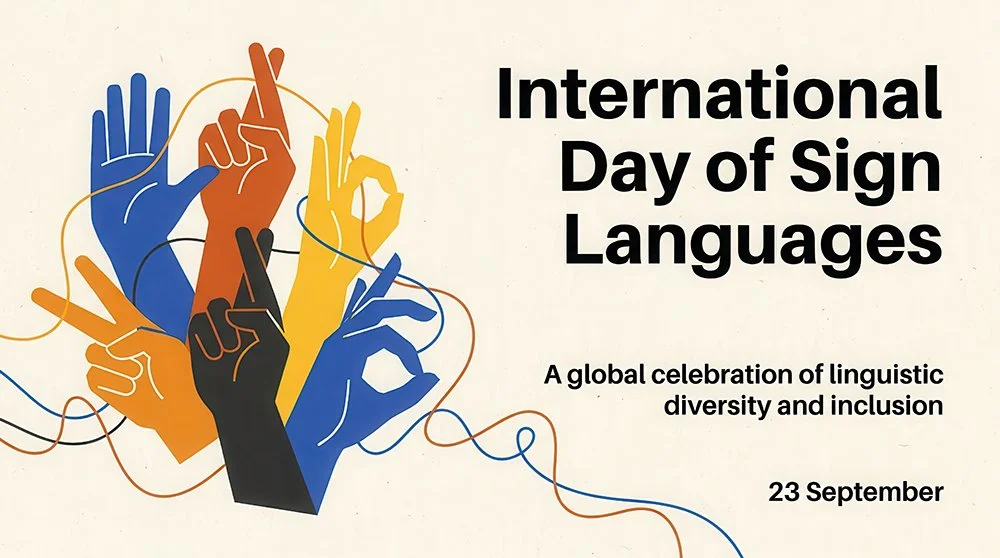
Image: A graphic shows multi colored hands all using sign language, with strings connecting them.
The United Nations General Assembly adopted a resolution in December 2017 establishing September 23 as the International Day of Sign Languages, and the world marked it for the first time in 2018. The date honors the founding of the World Federation of the Deaf in Rome in 1951, an organization that today represents national deaf associations in more than 130 countries. The day sits at the close of International Week of the Deaf, observed every year during the last full week of September since the World Federation of the Deaf began that tradition in 1958.
The Legal Floor: What Accessible Communication Requires
Section 504 of the Rehabilitation Act of 1973 and the Americans with Disabilities Act of 1990 both require effective communication from institutions that receive federal funding or serve the public. Effective communication means the format has to actually work for the person in front of you, whether that is a qualified ASL interpreter, real-time captioning, a note taker, or large print.

Image: An ASL interpreter stands behind a woman speaking into a microphone.
Title IV of the ADA, which took full effect on July 26, 1993, requires every U.S. telephone company to provide telecommunications relay services, so a deaf or speech-impaired caller can reach any hearing person by phone by dialing 711, free of charge. Video relay service came later and is now the primary way many ASL users make calls, signing to an interpreter over video who voices the conversation for the hearing person on the other end. The National Association of the Deaf continues to work with the FCC on call wait times, emergency access, and service quality, the same kind of steady, organized advocacy that has carried this community's priorities forward since 1880.
In Colorado, the state's Division of the Deaf, Hard of Hearing, and DeafBlind runs Legal Communication Access Services, which provides court-qualified interpreters and CART captioning for anyone who is a party, witness, or juror in a state court case, and by law, police and prosecutors must use its referral list when securing interpreters for an arrest or a witness interview. That is what effective communication looks like when it is built into a system instead of requested case by case, and it is a model for what the rest of accessible communication can grow toward. County meetings that offer interpretation and captioning by default, hospitals with a roster of qualified interpreters on call, and employers who recognize ASL fluency as the real, valuable skill it is.
Resources
None of this work happens alone, and Colorado already has a working network built for it. The organizations below cover interpreting, legal access, community, and education, and they're worth knowing before you need them, not just in the moment you do.
Colorado Division of the Deaf, Hard of Hearing, and DeafBlind: the state agency that connects Coloradans to interpreters, equipment, and communication access support. 720-457-3679, office.ccdhhdb@state.co.us
Legal Communication Access Services: the division's program providing court-qualified ASL interpreters and CART captioning for Colorado state court cases
Registry of Interpreters for the Deaf: the national certifying body for ASL interpreters, with a searchable directory to find and verify one
Colorado Association of the Deaf: the statewide membership organization run by and for Deaf Coloradans
Deaf Colorado: a community hub for Colorado Deaf news, events, and local ASL class listings
National Association of the Deaf: the national organization that has advocated for Deaf Americans and their language since 1880, including on telecommunications policy today
World Federation of the Deaf: the international organization representing national deaf associations in more than 130 countries
Telecommunications relay services: dial 711 from any phone to reach a free service connecting deaf, hard of hearing, or speech-impaired callers with hearing parties
Where We Grow From Here
This is a community with a long record of building its own institutions, teaching its own history, and organizing for what comes next, and that work continues. If you have run into a specific barrier, a meeting without an interpreter, a form with no plain-language version, a website with no captions, tell us about it. You can email us at infor@cpwd.org. Naming the barrier is where systems advocacy starts. If you are requesting an accommodation of your own, at work, in housing, or somewhere else, that is self-advocacy, and it is worth doing. And if you want to stay ahead of the bills and public comment periods that affect communication access, sign up for advocacy updates on our website so you hear about it while there is still time to act.