

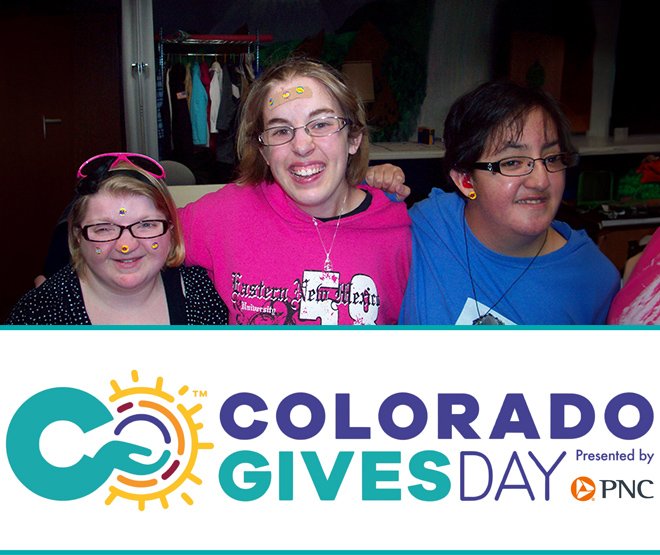
Image: Three girls with stickers on their faces smile at the camera. Below is the logo for Colorado Gives Day.
Colorado Gives Day is Tuesday, December 8, 2026, and early giving on ColoradoGives.org has been open since November 1. This article explains why Colorado Gives Day began, how it works, how CPWD started and what we do across our three offices, and how a gift made between now and December 8 goes further through the statewide Incentive Fund and a match for new monthly donors.
The Origins of Colorado Gives Day
In 2010, a study ranked Colorado among the least charitable states in the country, and Denver nonprofits were still feeling the effects of a long recession. Community First Foundation, now called Colorado Gives Foundation, answered with one idea: a single day when Coloradans would "Give Where You Live" by donating online to local nonprofits. With FirstBank as its partner, the foundation set a goal of raising $1 million on the first Colorado Gives Day, December 8, 2010. Donors gave more than $8.7 million to 539 Colorado nonprofits that day, including a $320,000 match from the Incentive Fund, created and funded jointly by Community First Foundation and FirstBank.
The day grew every year after that, and so did Colorado's reputation. In 2025, WalletHub ranked Colorado the 6th most charitable state in the nation, and about 62 percent of Coloradans reported making a charitable donation in 2023, the second-highest rate in the country. Last year's Colorado Gives Day set a record, with more than 102,000 donors giving $56.5 million. This year's Colorado Gives Day falls on December 8, sixteen years to the day after the first one.
How Colorado Gives Day Works
Since 2010, Colorado Gives Day has raised $581 million for nonprofits across the state. PNC is the presenting sponsor in 2026 (PNC Bank acquired FirstBank in September 2025).
Every donation made through ColoradoGives.org from November 1 through December 8 counts as a CO Gives Day gift, and early donations are eligible to receive a portion of the matching Incentive Fund. New, recurring donations will be matched up to $100 will funds are available, and other donations will receive proportionate matching funds based on total giving.
CPWD: A 30-Second History
CPWD began in Boulder County in 1977, founded by Judy Dixon and former Boulder County Commissioner Homer Page. Our first focus was helping people with disabilities find employment, and over nearly fifty years, that work has grown into the full set of independent living services we provide today.

Image: Judy Dixon and Homer Page are pictured in 1977, with Judy sitting in the passenger seat of a car.
Today CPWD is a cross-disability, non-residential Center for Independent Living, which means we work with people with any type of disability who live in their own homes and communities. More than half of our staff and board are people with disabilities. Our mission is to provide resources, information, and advocacy to assist people with disabilities in overcoming barriers to independent living.
We have offices in Boulder, Longmont, and Thornton, and we serve Adams, Arapahoe, Boulder, Broomfield, Clear Creek, Denver, Douglas, Gilpin, Jefferson, and Weld counties.
Your Gift Changes Lives
Your gift supports critical independent living services CPWD provides for people with disabilities and their families in our communities. We provide 5 Core Services and a continuum of specialized services, all at no cost to our consumers, to assist people with disabilities in overcoming challenges and barriers, and living independently.
Information & Referral
What it is: A starting point for anyone looking for answers or local resources.
How it Supports Independence: CPWD answers questions about their own programs and connects people to outside resources, like housing, transportation, assistive technology, and benefits, so they know their options and can make informed choices.
Independent Living Skills Training
What it is: Practical, hands-on training for everyday life.
How it Supports Independence: Staff teaches skills that build day-to-day independence, including budgeting, shopping, cooking, using public transportation, home safety, using assistive technology, and applying for benefits.
Individual and Systems Advocacy
What it is: Standing up for disability rights at both the personal and community levels.
How it Supports Independence: On an individual level, CPWD teaches people about their rights (as tenants, employees, or patients) and assists them in building the confidence to speak up for themselves. On a systems level, CPWD works with lawmakers, agencies, and community leaders to improve laws, policies, and public accessibility.
Peer Support
What it is: Connecting with others who share similar lived experiences.
How it Supports Independence: People with disabilities meet one-on-one or in groups (both online and in person) to share challenges, celebrate successes, exchange practical tips, and build friendships and encouragement.
Transitions (Youth & Nursing Home)
What it is: Step-by-step guidance through major life changes.
How it Supports Independence:
Youth Transitions: Assists young people (ages 14–24) moving from high school into adulthood by building life skills, exploring careers, and finding jobs (such as through their summer Youth Employment Program).
Nursing Home Transitions: Assists people in moving out of nursing facilities and back into their own homes by securing accessible housing, setting up home health care, and arranging benefits.
These core services are the foundation of our other programs.

Image: A deafblind woman communicates with her Support Service Provider.
Beyond Vision: Assists people with visual impairments or blindness in living independently through one-on-one services, group trainings, assistive technology instruction, and peer support groups.
Employment: Supports job seekers with disabilities through Career Coaching (job preparation, interviewing, and workplace accommodations) and the Ticket to Work program, which guides individuals on Social Security benefits back into the workforce.
Benefits Counseling: Connects individuals with certified counselors (CPWICs) who analyze how earned income affects public benefits so people can pursue employment without unexpectedly losing their financial security.
SSI/SSDI: Provides certified Non-Attorney Representatives and an Attorney to guide individuals through Supplemental Security Income (SSI) and Social Security Disability Insurance (SSDI) applications, appeals, hearings, and court processes.
VIP (Veterans Independence Program): Partners with the VA across Colorado, Wyoming, Nebraska, Iowa, and California to assist Veterans with disabilities in living at home by letting them choose and hire their own caregivers (including family members) and save toward equipment or home modifications.
We have several bilingual staff members and provide services in various formats and presentations to make them accessible for anyone with any disability.
Make Your Gift Today!
Any gift made through ColoradoGives.org between November 1 and December 8 counts toward Colorado Gives Day, and every one of those gifts earns CPWD a share of the Incentive Fund, no matter which day you give. However, matching funds are awarded on a first-donated-first-matched basis, so early donations have a better chance of getting a match.
How to Make Your Gift
Give once. Visit CPWD's page on ColoradoGives.org and click Donate.
Give monthly. Choose a recurring donation, and Colorado Gives Foundation will match your first gift up to $100 while the match fund lasts.
Fundraise for us. Use the Fundraise button on our ColoradoGives.org page to start your own campaign and invite friends, family, or coworkers to give with you.
Stay Connected
Giving is one way to be part of this work, and there are others. If you or someone you know is running into a barrier to living independently, call us at 303-442-8662 or email info@cpwd.org. You can also sign up for advocacy updates on our website, so you hear about bills, hearings, and public comment periods while there is still time to act. Thank you for standing with us this season and all year.