


Image: A wheelchair user uses an accessible voting booth.
Voting in Colorado on November 3
Election Day in Colorado is Tuesday, November 3, and every ballot must reach an official dropbox or a Voter Service Polling Center by 7 p.m. sharp that evening. As people with disabilities, we have the right to vote privately and independently, and we also have the right to get assistance whenever we want it.
This article covers three things. First, it tells how a focus group at CPWD helped the Colorado Secretary of State improve the accessible electronic ballot. Second, it explains what those improvements mean for this election. Third, it walks through the practical steps for returning your ballot, voting in person, and tracking your vote, along with the organizations that can help.
How Our Focus Group Shaped the Accessible Ballot
Colorado lets voters with print disabilities mark their ballots online, using the screen readers and other assistive technology they already rely on. A print disability is any disability that makes it hard to read or handle a paper ballot, including blindness or low vision, a physical disability that makes holding or marking a ballot difficult, or a learning disability such as dyslexia. Basically, this means a voter who is blind or has low vision can read and mark the ballot privately, without asking someone else to fill it in for them.
In March 2025, CPWD hosted a focus group at our office with the Secretary of State's office to test that electronic ballot for accessibility. Voters who use assistive technology worked through the whole process and named every point where something could stop a person from finishing their ballot on their own. The Secretary of State's office took that feedback back to its team and began making changes.
What Changed Because We Spoke Up
The Secretary of State's office has made two improvements so far, and both came directly from what focus group participants found.
An accessible version of the ballot affidavit
Every electronically marked ballot must be returned with a signed affidavit, which is the form that confirms who you are. The affidavit is a PDF, and focus group participants found that it lost its accessibility features when the ballot marking system produced it, so a screen reader could not read it reliably. The Secretary of State's office solved this by adding a new page to the voting process that shows all of the affidavit's information in an accessible web format before you download the PDF. You can now read every detail, correct anything that is wrong, and then download a PDF that contains the same information, so you know your affidavit is accurate before you return it to your county.
A larger signature box on phones
Voters who sign on a mobile device can now turn the phone sideways while signing. Before this update, the signature box was small and only worked with the phone held upright. Rotating the phone gives you a wider space to sign. The focus group gave a lot of feedback about the signature tool, and the Secretary of State's office describes this update as a first step, with more improvements planned based on what voters report.
This is what systems advocacy looks like. When people with disabilities are at the table testing the tools we use, the tools get better for everyone who comes after us.
How to Vote in This Election
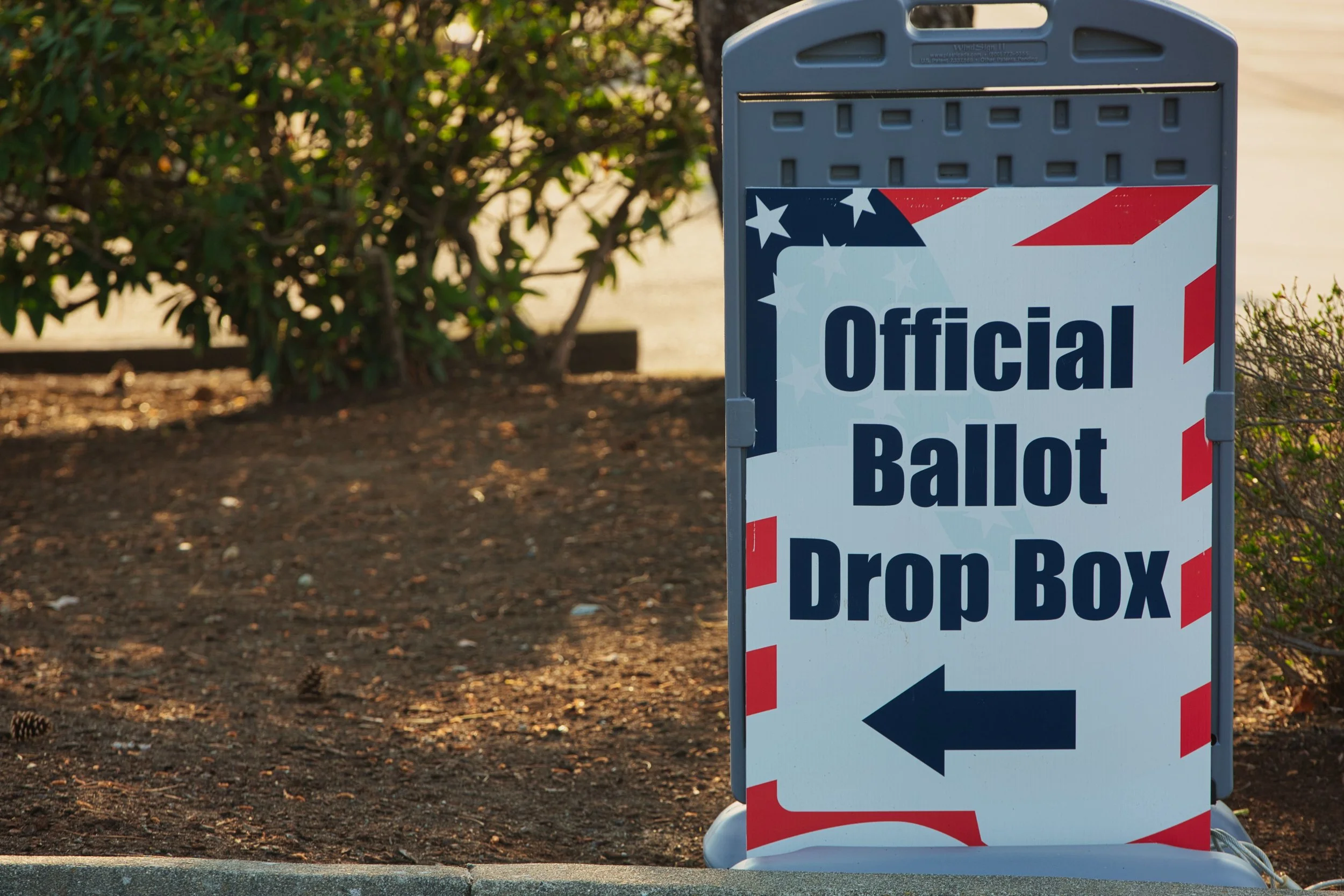
Image: A sign points to an official ballot drop box.
Returning your ballot to a dropbox
Official drop boxes accept ballots until 7 p.m. sharp on Election Day, November 3. We recommend dropping off your ballot as early as you can, and leaving extra travel time if you live in a rural area. Your dropbox must be in the same county as your registered voting address, so check your registered address before you go. Colorado has hundreds of drop boxes, and you can find an official drop box near you on the Secretary of State's website.
Registering and voting in person
Colorado has no deadline for voter registration. Anyone who has lived in Colorado for at least 22 days can register, including on Election Day itself, and you can check the eligibility requirements and get started at Just Vote Colorado.
In-person voting is open until 7 p.m. on November 3 at Voter Service Polling Centers, and you can find a voting center near you. We do not recommend waiting until the last minute. Still, if you are in line at a Voter Service Polling Center by 7 p.m. sharp, you have the right to stay in line until you vote.
Tracking your ballot
Once you have voted, you can track your ballot, and we encourage you to do so. Tracking lets you confirm that your county received and counted your ballot. The Secretary of State's office explains how to track your ballot through its BallotTrax service.
Resources for voters with disabilities
The Secretary of State's Voters with Disabilities FAQs give a clear overview of our voting rights in Colorado.
Disability Justice leads the work of protecting voting rights for people with disabilities in Colorado. If you believe your rights have been violated, or if you have a concern about access, contact them.
The Colorado chapter of the National Federation of the Blind answers questions about voting access for people who are blind. Curtis Chong, the chapter's Voting Rights Coordinator, can be reached at chong.curtis@gmail.com or 303-778-1130.
The National Federation of the Blind's Step-by-Step Guide for Using Accessible Online Voting walks voters with print disabilities through the electronic ballot.
Think Change offers a free training called Election Basics: Your Vote Is Your Voice, along with a Plain-Language Colorado Ballot Guide.
Keep Telling Us What You Find
The improvements to Colorado's electronic ballot started with voters naming the barriers they ran into. If something about voting gets in your way this year, whether it is a dropbox you cannot reach, a polling center that is not accessible, or a step in the online ballot that does not work with your assistive technology, tell us. Systems advocacy begins with one person describing a barrier clearly, and we carry that information to the people who can change it.
To share what you experience, or to ask a question about voting access, contact Craig Towler, our Director of Public Policy and Advocacy, at craig@cpwd.org or (303) 442-8662. You can also sign up for advocacy updates on our website, so you hear about the next chance to test a system, comment on a rule, or speak up while there is still time to act.
You have the right to vote privately and independently. You have the right to help when you want it. And you have a community working to make every part of the process accessible.