

Two Months, One Movement: Celebrating the Intersection of LGBTQ+ and Disability Pride
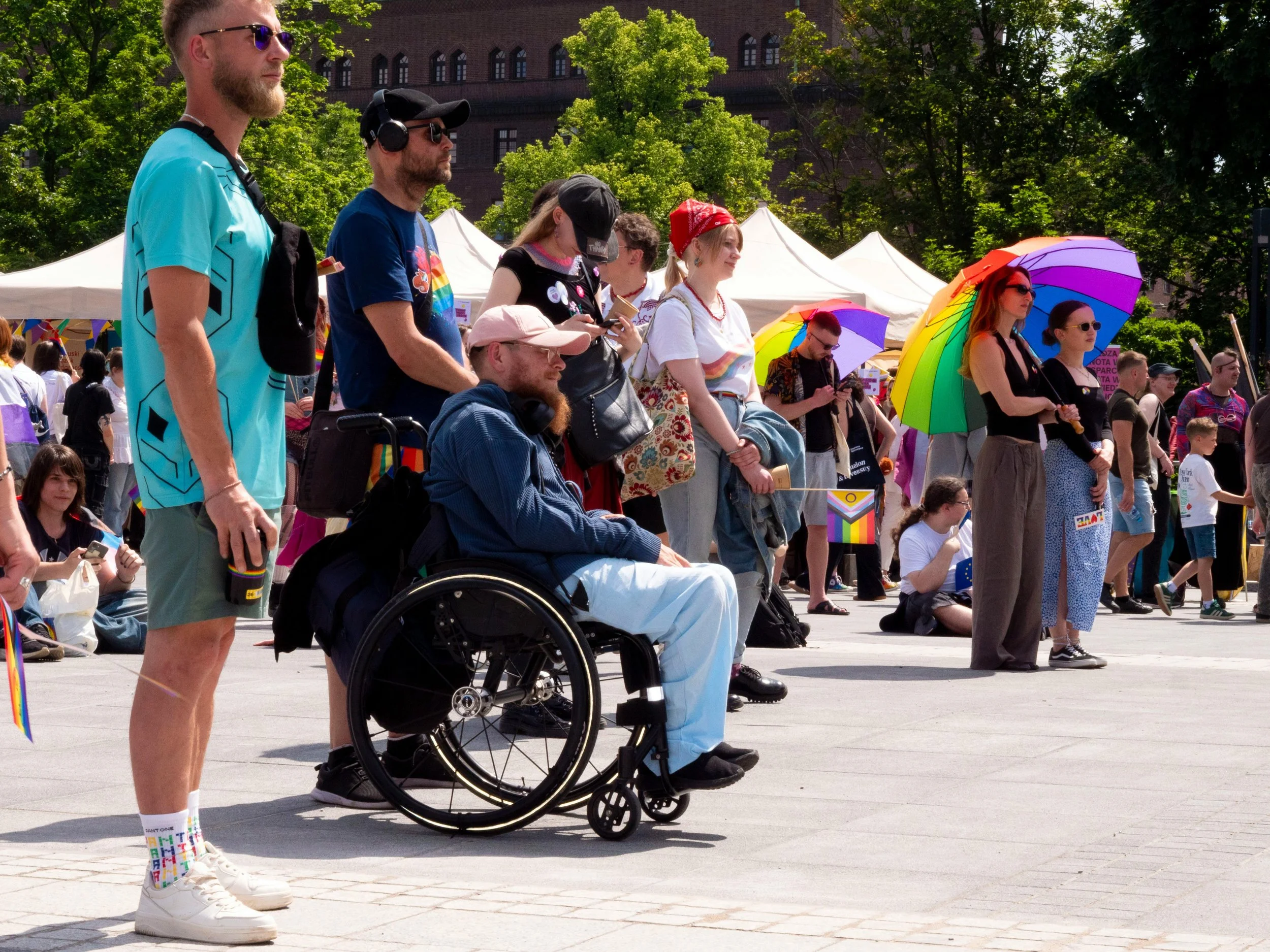
Image: A group of people gathers at Pride Fest. There are rainbow umbrellas and flags in the background. A man near the front is a wheelchair user.
June arrives each year as a burst of color, visibility, and community. Pride Month, with its parades, festivals, and declarations of self-determination, has grown into one of the most powerful cultural observances in the country. And right on its heels comes July, carrying Disability Pride Month forward, honoring the 1990 passage of the Americans with Disabilities Act and the long, ongoing fight for full inclusion.
For many people, these two months feel like separate celebrations. But for a significant and often overlooked part of our community, they are not separate at all. They are one story told in two chapters.
The Numbers Tell a Story We Can't Ignore
The overlap between the LGBTQ+ and disability communities is not a coincidence or a footnote. It is a defining reality. According to a 2024 Human Rights Campaign Disabled Youth Report, 36% of LGBTQ+ adults self-report having a disability, compared to 24% of non-LGBTQ+ adults. A 2025 study published in BMC Public Health found that 13% of people with disabilities identify as LGBTQ+, nearly double the rate of their peers without disabilities. Among transgender people specifically, the numbers are even more striking: research from Health Affairs found that transgender adults have nearly twice the rate of disability as their cisgender counterparts at nearly every age.
These are not abstract statistics. They are people like our neighbors, our clients, our colleagues, our friends, who navigate the world holding multiple marginalized identities at once. People who experience what researchers call 'double discrimination' have also become some of the most powerful voices for intersectional justice, pushing both the disability rights and LGBTQ+ movements to be more inclusive, more intersectional, and more honest about who gets left out.
A 2024 report from the Center for American Progress found that discrimination significantly affected the mental well-being of 52% of LGBTQ+ adults, and that number jumped to 61% for LGBTQ+ adults with disabilities. These numbers are not theories or trends; they represent lived reality, and the need for intersectional advocacy. Shared Roots, Shared Struggle
To understand why these communities belong in conversation with each other, it helps to remember where both movements began.
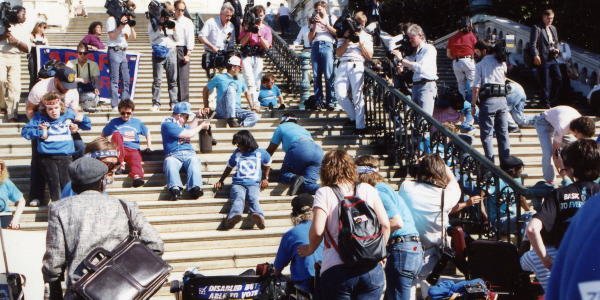
Image: During the Capitol Crawl in 1990, people abandoned their wheelchairs and mobility devices to crawl up the steps of the Capitol building in protest.
LGBTQ+ Pride traces its roots to the Stonewall Uprising of 1969, when queer and transgender people, many of them people of color, many of them poor, some of them with disabilities, fought back against police raids at the Stonewall Inn in New York City. It was a rebellion rooted in the demand for dignity and self-determination.
Disability Pride draws its founding moment from the ADA, signed into law on July 26, 1990, but the movement behind it had been building for decades. In 1990, dozens of disability rights activists abandoned their wheelchairs and crawled up the steps of the U.S. Capitol in what became known as the Capitol Crawl, demanding access to public life that most Americans took for granted. Like Stonewall, it was an act of bodily protest. A declaration that these bodies, these lives, belong here, too, and deserve dignity and respect.
Both movements insist on the same core truth: that difference is not deficiency, that marginalization is a political condition and not a personal failing, and that community is the ground on which liberation is built.
What Pride Looks Like When Everyone Is Welcome
The overlap between these communities has real implications for how we celebrate, organize, and design spaces together.
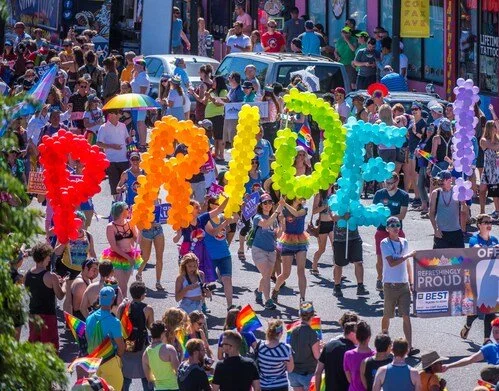
Image: Participants walk in the 2025 Denver Pride Parade. Image courtesy of DenverPride
Denver PrideFest, one of the largest Pride celebrations in the country, has taken meaningful steps toward accessibility. The festival offers accessible seating sections with large tents and folding chairs, ASL interpretation at the parade along Colfax Avenue, and on-site medical staff trained to address communication-assistance needs. It explicitly recognizes the disability rights movement and the ADA as part of the civil rights tradition that Pride honors.
That is progress worth naming. And it is also, as many disability advocates will tell you, a starting point. Full inclusion means designing events from the beginning with the full range of human experience in mind: sensory-friendly spaces, flexible seating throughout the venue, accessible transportation routes, interpretation services, and representation on stage and in leadership.
Right here in Boulder County, Rocky Mountain Equality (RMEQ) hosts Pride events across our communities, including Longmont Pride on June 6, 2026, at Roosevelt Park. It is an outdoor, family-friendly celebration with performances, community partners, and resources for all. RMEQ's mission centers equity and inclusion across all identities, and their programming spans LGBTQ+ youth, families, aging adults, and QTPOC communities. As Pride events continue to evolve, weaving disability inclusion into celebrations from the beginning is important and worth celebrating.
The 2026 Disability Pride Theme: "The World Works Better With Us"
This July, Disability Pride Month carries a theme that resonates far beyond the disability community: "The World Works Better With Us." It is a statement about contribution, belonging, and the fundamental value of human diversity in all its forms.
Image: A graphic that has a rainbow colored ribbon at the bottom, while near the top of the image it says “July is Disability Pride Month” on a black background.
It is also a statement that applies to the LGBTQ+ community. The world works better when queer people live authentically. It works better when people with disabilities have full access to public life. And it works better still when the people holding both identities, queer and part of the disability community, in all the intersections that entails, are seen, supported, and celebrated.
The history of accessibility is also a history of innovation that transformed everyday life for everyone. Curb cuts, designed for wheelchair users, became essential infrastructure for parents with strollers, delivery workers, and cyclists. Closed captioning, created for Deaf viewers, is now used by millions in gyms, airports, and living rooms. Voice-activated technology, developed to support people with mobility and vision disabilities, is now how many of us set timers and send texts. This is the principle of universal design: when we build for the full range of human experience, we build something that works better for all of us.
The same logic applies to communities. When Pride events are designed from the start with sensory-friendly spaces, accessible routes, ASL interpretation, and representation on stage, they become richer, more welcoming celebrations for everyone. When the LGBTQ+ and disability communities build together rather than in parallel, the result is not just accommodation; it is belonging.
What You Can Do This Summer
As we move through Pride Month in June and into Disability Pride Month in July, here are some ways to honor both:
Attend with awareness. When you go to a Pride event, notice the accessibility features and notice the gaps. If something is not working, say something. Your voice matters.
Amplify the voices of LGBTQ+ people with disabilities. Seek out writers, artists, advocates, and community leaders who hold both identities. The Disability Visibility Project, founded by Alice Wong, is an excellent starting point. So is the work of Mia Mingus, whose writing on "access intimacy," the ease we feel with people who genuinely understand our access needs, has shaped how many communities think about belonging.
Support organizations doing intersectional work. CPWD serves people with disabilities across Boulder County regardless of sexual orientation or gender identity. Rocky Mountain Equality serves LGBTQ+ people across Colorado. When these organizations work in relationship with each other, the community is stronger.
Rocky Mountain Equality hosts Pride events across Boulder County all month long. Longmont Pride is on June 6 at Roosevelt Park, 700 Longs Peak Ave, from 11 am to 4 pm. Boulder Pridefest follows on June 13 at the Boulder Main Library Parking Lot, 1001 Arapahoe Ave, also from 11 am to 4 pm. Bring your family, your questions, your joy. Everyone is welcome here.
This is a conversation CPWD has been part of for a while. Last year we explored the historical roots connecting these two movements in our piece Pride, Power, and the Call for Equality: Celebrating the Intersection of LGBTQ+ and Disability Pride, tracing the thread from Stonewall to the Capitol Crawl and the shared belief that difference is not deficiency. If you want the historical foundation alongside this year's data and community resources, read it here.
Are you, or is someone you know, a person with a disability who also identifies as LGBTQ+? CPWD is here for you. Our services are available to all people with disabilities in Boulder County, regardless of sexual orientation or gender identity. If you or someone you love needs support achieving or maintaining independent living, we'd welcome the conversation. Reach us at info@cpwd.org or visit cpwd.org to learn more about what we offer.