

Living Fully: What Limb Loss and Limb Difference Awareness Month Is Really About
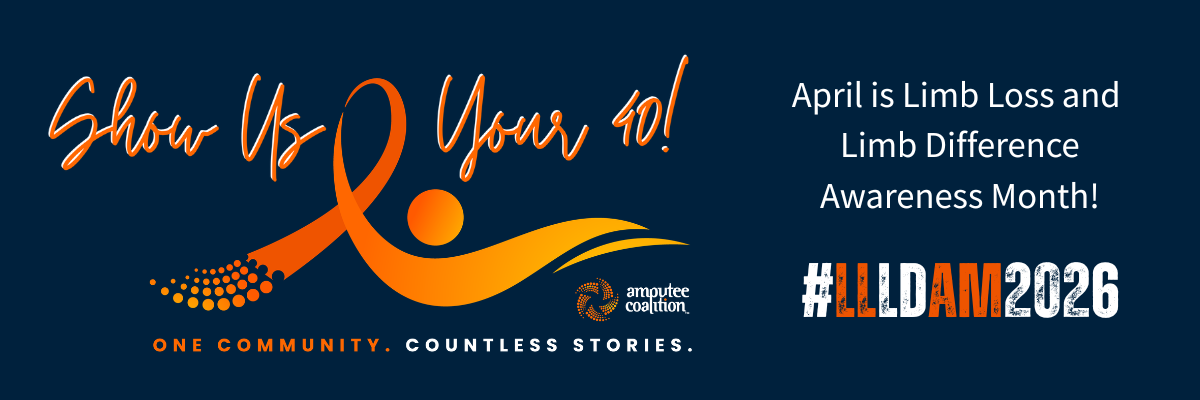
Image: A graphic that say “Show us Your 40” on the left, with the Amputee Coalition below. On the right it says “April is Limb Loss and Limb Difference Awareness Month. #LLLDAM2026”
Every April, Limb Loss and Limb Difference Awareness Month (LLLDAM) gives us an opportunity to shine a light on one community within the broader disability community: people with limb loss and limb difference, and to talk honestly about the barriers they face and the support they deserve.
More than 5.6 million Americans live with limb loss or limb difference. That’s a significant portion of our population. They are in our communities, among our friends and families. For people with limb loss or limb difference, navigating the world - transportation, technology, communications- can be challenging and present barriers. As a Center for Independent Living (CIL) we address these challenges in two ways: 1) we provide skills training, resources and information and assist people in finding and learning the tools and skills they need to live independently; and 2) we advocate at the levels of public planning and awareness, policies and laws to promote changes that will increase accessibility, equity, and inclusion. This article explores limb loss and limb difference, what independent living looks like for this community, what full inclusion in the workplace requires, and some of the exciting technology that’s increasing independence for people with limb loss or limb difference.
Limb Loss and Limb Difference Are Not the Same Thing
We use “limb loss and limb difference” as a shared term, but it’s important to understand that these are two distinct experiences, and treating them as interchangeable can lead to misunderstandings and, sometimes, to support that misses the mark.
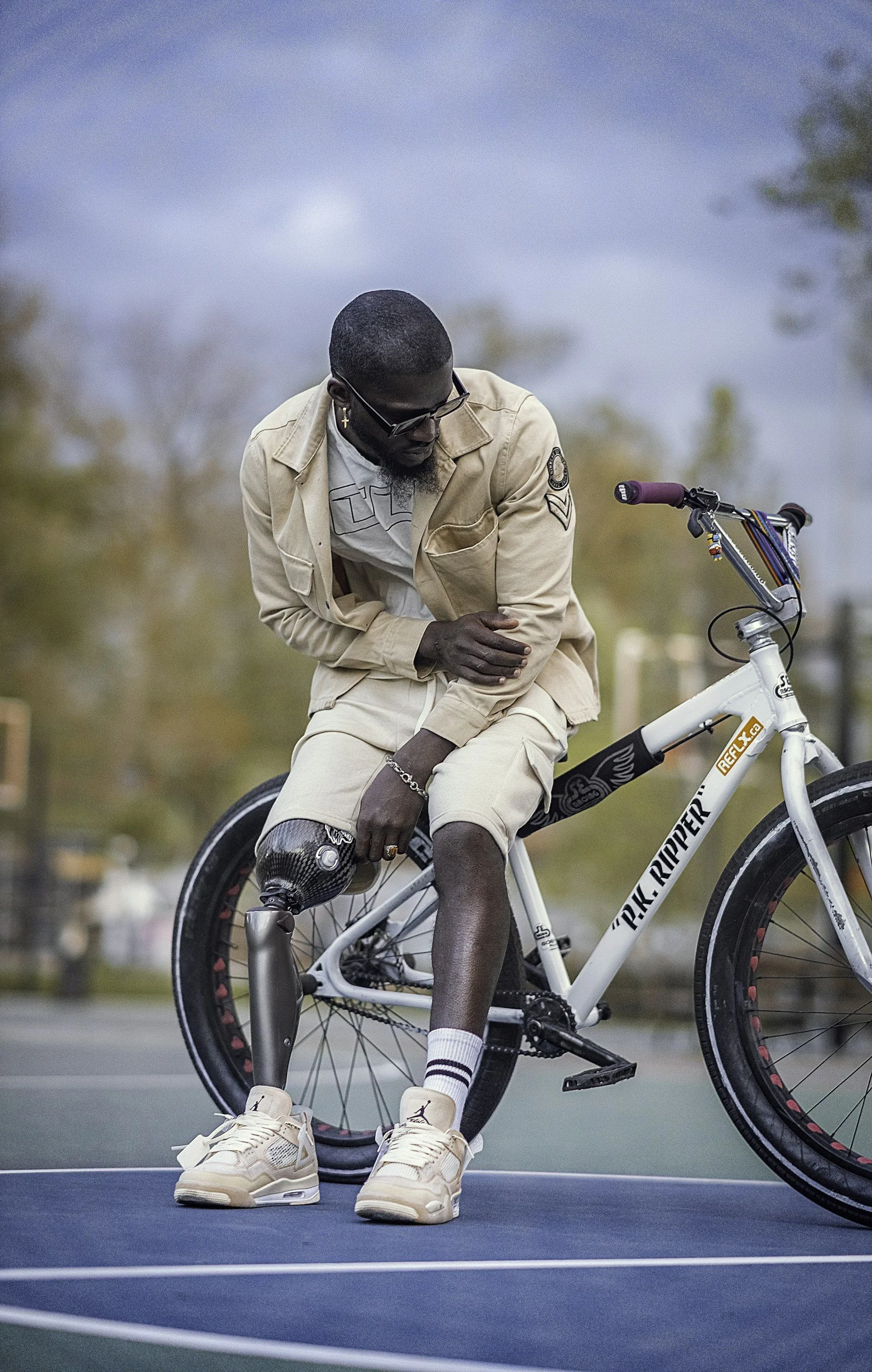
Image: A man with a prosthetic leg leans against his bicycle.
Limb loss, or acquired amputation, happens when a limb is removed due to illness, injury, or medical necessity. According to the Amputee Coalition, vascular disease, which includes diabetes and peripheral artery disease, accounts for about 54% of amputations. Trauma accounts for approximately 45%, and cancer for less than 2%. For many adults, limb loss is a sudden, life-altering event. There is grief. There is physical rehabilitation. There is the very real process of learning to move through the world in a body that has changed, often without warning.
Limb difference is something else. It refers to being born with a limb that is absent, underdeveloped, or structurally different. The CDC estimates that about 1 in every 1,900 babies born in the U.S. each year has a congenital limb difference. Research has shown that children born with limb differences generally do not experience the same feeling of loss that adults do after amputation. Instead, they develop adaptive ways of doing things from the very beginning by figuring out their own approaches to movement, tasks, and the world around them.
That doesn’t mean it’s easy. Growing up with a limb difference means navigating the social world: the stares, the questions, the environments that assume everyone has fully functioning limbs. It means going to school, applying for jobs, and building a life in a world that is easier to operate in without limb difference. The challenges are real. The lifelong experience is different.
Whether someone has limb loss or limb difference, they will face challenges and barriers as they go through life. Living independently, going to work, shopping, cooking, raising a family, recreation, and most parts of living will require some adaptive support, skills training, and accommodations. That’s perfectly normal, and we believe in continuously rebuilding our systems and spaces to be increasingly accessible and inclusive for all people, regardless of ability.
Independent Living: It’s About Self-Determination, Not Going It Alone
At CPWD, we talk a lot about independent living. It’s important to understand what we mean. Independent living doesn’t mean doing everything on your own. It means having real control over the decisions that shape your life, from where you live, how you work, what support you need, and more. It’s a framework rooted in the belief that people with disabilities are the experts on their own lives, not the systems that serve them. And, at the same time, it’s about shared experience and support, about having access to services, peer groups, people, and places that can teach you, assist you, encourage you. It’s about knowing that you are respected for your individual sovereignty, but you are not going it alone.
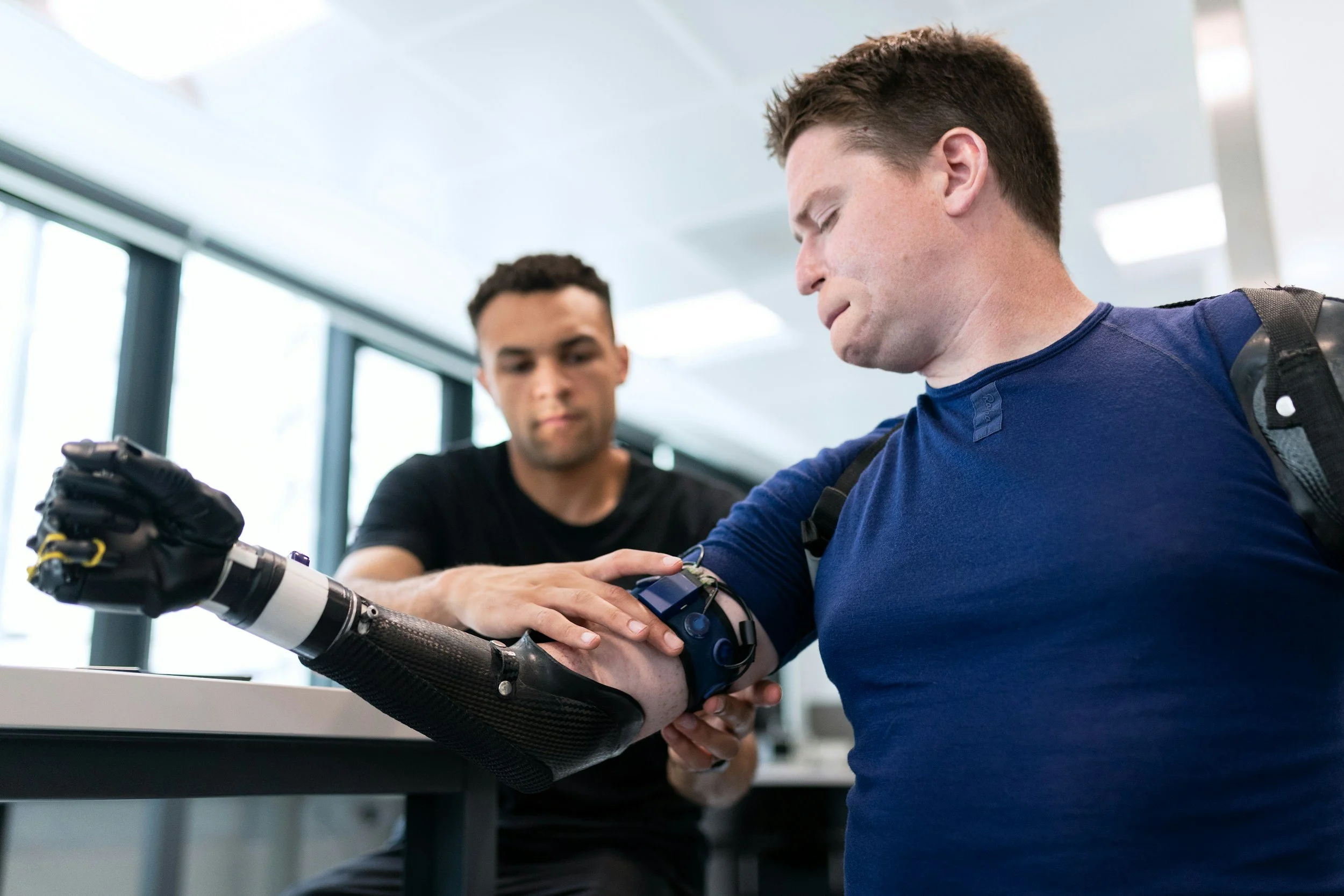
Image: A man looks down at the prosthetic arm that is being fitted to his upper arm.
For people with limb loss and limb difference, achieving that kind of self-determination often means navigating many moving parts at once. After limb loss, there’s the immediate physical work: wound care, prosthetic fitting, and mobility rehabilitation. But the longer journey is about rebuilding confidence, adjusting to a new relationship with your body, and figuring out how to do the daily things that the rest of the world takes for granted.
Depression affects approximately 36% of people living with limb loss. That emotional experience has a powerful impact, affecting people’s health, finances, and even the feeling of wanting to live or not. That’s why having community inside of rehabilitative services is so critical. Peer support, talking to others who have experienced this too, is essential for restoring hope, confidence, and the will to live.
Healthcare costs for this community are significantly higher than for people without disabilities. Prosthetics range from $3,000 to $100,000. Wheelchairs and other adaptive equipment are expensive. Ongoing physical therapy, outpatient care, and clinical visits continue long after discharge. And for those whose amputation was caused by vascular disease, the risk of additional health complications such as cardiovascular disease, diabetes-related conditions, and, in many cases, a second amputation, can extend the medical journey for years. Lifetime healthcare costs for people with limb loss are estimated at approximately $509,275 compared to $361,200 for people without limb loss.
Insurance coverage usually doesn’t cover all the associated costs and needs. Some policies cap prosthetic coverage at $10,000 over a lifetime, leaving people to pay the difference out of pocket. Premiums tend to increase while benefits are restricted. Navigating the economics alone of limb loss can be challenging, on top of the significant emotional, psychological, and physical life changes.
When medical care ends, life doesn't pause. And for many people with limb loss, that transition from hospital or rehab back into daily life is where things get real. It’s one thing to survive and navigate hospitalization and all the inherent complexities. It’s another thing to try to “get back to life,” when most of the time, you can’t go back to that life. You have to both learn how to function in the world with limb loss and build a new life at the same time. One of our staff shared how when he lost his legs in an auto accident, he could go home, because his apartment was on the 2nd floor and only accessible through a steep stairwell. He had been a runner and an athlete. That changed overnight. He had to find a way not only to tend to the immediate medical needs, but also to find accessible living, and reinvent his life, work, and passions. See Craig’s Story.
This is where organizations like CPWD come in. Centers for Independent Living were created specifically to bridge that gap by offering peer support, options counseling, and community-based services that help people figure out their own path forward. We’re not clinical, and we’re not prescriptive. We work alongside people, not in front of them.
Peer support, in particular, is one of the most powerful tools available to people adjusting to limb loss. One study found that 92% of patients who had a peer visit said it substantially improved their outlook. Hearing from someone who has been through a similar experience and is living well is something no clinical appointment can replicate. The Amputee Coalition’s Certified Peer Visitor program connects people with trained volunteers who have firsthand knowledge of what it’s like, and CPWD’s own peer support services work in a similar spirit.
For people with congenital limb differences, independent living starts earlier; in classrooms, on playgrounds, and in families and communities that either make room for them or don’t. The foundation built in childhood matters. Adaptive sports, inclusive environments, and adults who lead with possibility rather than limitation all shape what independence looks like later in life.
If you or someone you know could benefit from independent living support, peer connection, or options counseling,reach out to CPWD. That’s what we’re here for.
The Workplace: What Inclusion Actually Requires
Employment is one of the biggest arenas where people with limb loss and limb difference run into barriers. And it’s an area where, with the right support and the right employer attitudes, real change is possible.
Many people do return to work after limb loss. But it often takes time and the right conditions. One study from 2006 of individuals who experienced traumatic lower-limb amputation found that about 58% had returned to work seven years after their injury. And even then, many reported ongoing limitations in performing their job duties. For people in physically demanding roles, the path back may require retraining or a career transition. For others, it might simply require a few accommodations.
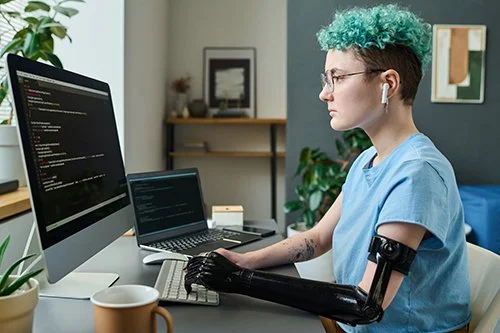
Image: A person with a prosthetic arm works at their computer.
Under the Americans with Disabilities Act (ADA), people with limb loss and limb difference are protected from employment discrimination and entitled to reasonable accommodations. The Job Accommodation Network (JAN) notes that this can include modified equipment, ergonomic workstations, flexible scheduling, task reassignment, or remote and hybrid work options. Here’s something that surprises many employers: research shows that more than half of workplace accommodations cost nothing at all, and 80% cost less than $500. The barrier is rarely financial, but is usually found in a lack of awareness and willingness.
JAN is a free resource that helps both employees and employers identify practical, effective accommodations. JAN consultants work directly with people to find solutions that fit the individual and the job. You can explore their amputation-specific guidance here.
CPWD’s Employment Program supports people with disabilities through every stage of this process, from job searching and resume building to navigating disclosure decisions and requesting accommodations. The ability to work, contribute, and build financial stability is central to independent living. And disability doesn’t determine what someone can contribute. However, an inclusive workplace determines whether they have the opportunity to show it.
Prosthetic Technology: A Remarkable Frontier
The technology available to people with limb loss has advanced dramatically in recent years, and what’s happening right now is genuinely remarkable.
In 2024, MIT researchers published a study in Nature Medicine on a bionic leg system that allows people to control their prosthetic limb directly through their own nervous system. Patients using this system walked 41% faster than those with traditional prosthetics, navigated obstacles more naturally, and described the prosthetic as feeling like a genuine part of their body rather than a tool.
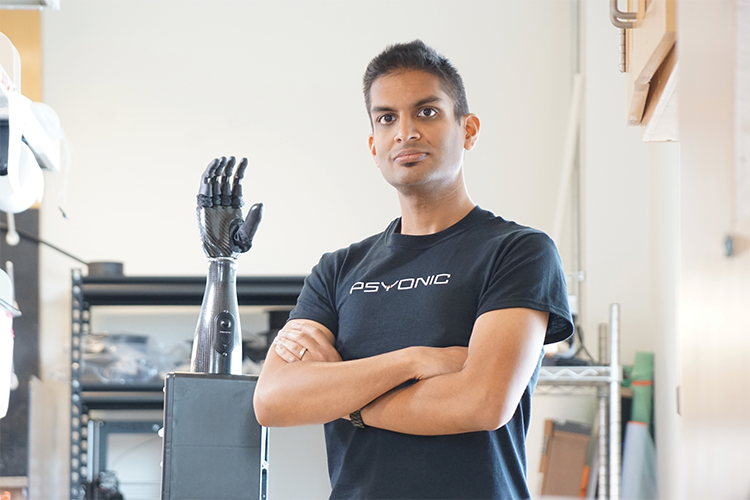
Image: PSYONIC’s CEO and Founder, Aadeel Akhtar, Ph.D., with the Ability Hand1. (Photo courtesy of PSYONIC.)
Also in 2024 and 2025, researchers at the University of Chicago and the University of Pittsburgh made significant advances in restoring the sense of touch through brain-computer interface technology. Studies published in Nature Biomedical Engineering and Science demonstrated that precisely timed electrical stimulation of the brain’s sensory cortex could create stable, localized sensations of touch, moving closer to the kind of intuitive, feeling-based feedback that most people never think twice about.
3D printing has also changed the landscape. What once required expensive, specialized manufacturing can now be produced faster, at lower cost, and customized to an individual’s anatomy and personal preference. Companies like PSYONIC have used 3D printing and soft robotics to develop more durable, responsive prosthetic hands at a fraction of the cost of traditional devices.
All of this is exciting. And it comes with an important question: who gets access?
Advanced prosthetics remain out of reach for far too many people. Insurance coverage is inconsistent. Costs are high. Access to specialized prosthetists is unevenly distributed across geographic and income groups. Black Americans face amputation rates up to four times higher than white Americans. This is largely driven by disparities in diabetes care and vascular disease treatment, and they are less likely to have the insurance coverage or financial resources to access cutting-edge devices. Technology that exists but isn’t accessible isn’t a win yet.
Colorado’s House Bill 23-1136, which went into effect in March 2025, expanded insurance coverage for prosthetic and orthotic devices. This is a meaningful step forward. But ensuring that innovation actually reaches the people who need it requires sustained policy advocacy, community organizing, and pressuring systems, like insurance companies, to improve services and benefits.
What We Can All Do
So why does all of this matter? Because 5.6 million Americans are navigating a world that still has significant work to do in how it employs people with limb loss and limb difference, how it delivers healthcare equitably, how it builds spaces and systems that work for everyone, and how it makes room for people to live fully on their own terms.
This April, the Amputee Coalition is marking its 40th anniversary with year-round programming under#LLLDAM2026. Every Wednesday in April, you can wear orange and share a photo using #WearOrangeWednesday and #LLLDAM2026 to show support. You can also take the Proclamation Challenge to help get LLLDAM officially recognized in all 50 states, or connect with the National Limb Loss Resource Center for information, peer support, and resources.
And if you’re in Colorado and looking for support, whether you’re navigating life with a disability, looking for employment help, or trying to figure out your next step, CPWD is here. Contact us at (303) 442-8662 or info@cpwd.org. Independent living is possible, and no one has to do it alone.