

Mobility Awareness, Accessibility, and the Future of Inclusive Communities.
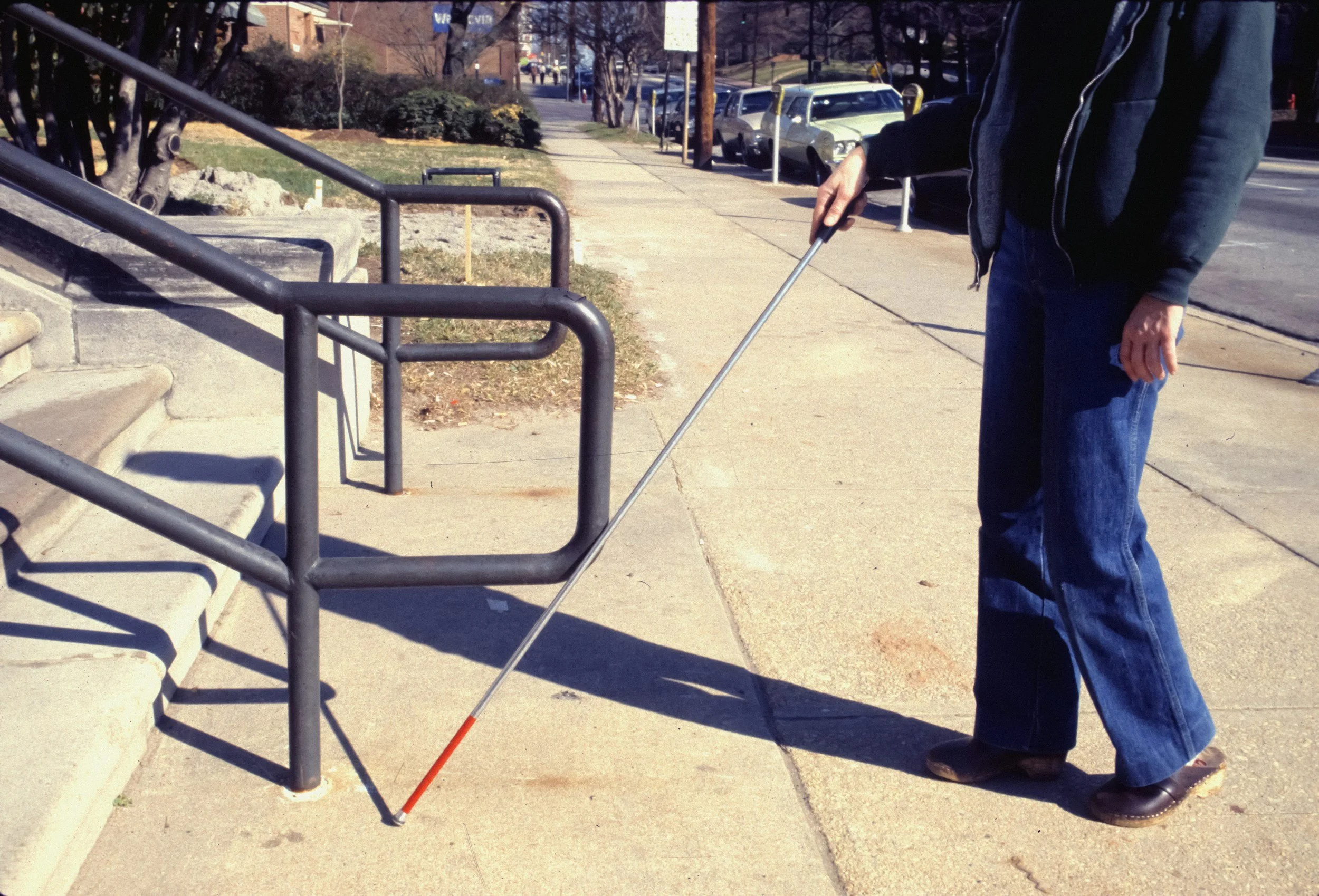
Image: A person who is blind approaches a set of stairs while using a white cane.
For many people, mobility is something that fades quietly into the background of everyday life. Walking into a grocery store, crossing a street, taking public transportation, entering a workplace, or navigating a sidewalk are often treated as ordinary routines that require little thought. Yet for millions of people with disabilities, mobility is something that must be intentionally navigated every single day. It involves planning, adaptation, awareness, accessibility, and the ability to move through systems that were not always designed with inclusion in mind.
Mobility Awareness Month provides an opportunity to examine how mobility impacts independence, participation, and quality of life for people with disabilities. It also offers a chance to recognize the decades of advocacy that have reshaped accessibility in the United States and around the world.
According to the Centers for Disease Control and Prevention, more than 61 million adults in the United States, approximately one in four adults, live with a disability. Mobility disabilities remain among the most commonly reported disability categories.
Globally, the World Health Organization estimates that approximately 1.3 billion people experience significant disability. The organization also identifies inaccessible transportation systems and infrastructure as major barriers to participation, employment, healthcare access, and community inclusion for people with disabilities.
While conversations around mobility often focus primarily on wheelchairs or visible disabilities, mobility awareness encompasses a much broader spectrum of experiences. People with disabilities may use white canes, walkers, prosthetics, forearm crutches, service dogs, mobility scooters, adaptive bicycles, or other assistive technologies. Others may experience mobility limitations connected to chronic illness, neurological conditions, chronic pain, fatigue, traumatic brain injuries, or balance disorders. Some disabilities are visible, while others are not immediately apparent.
At its core, mobility is about independence, dignity, opportunity, and equal participation in society.
Meet Maya
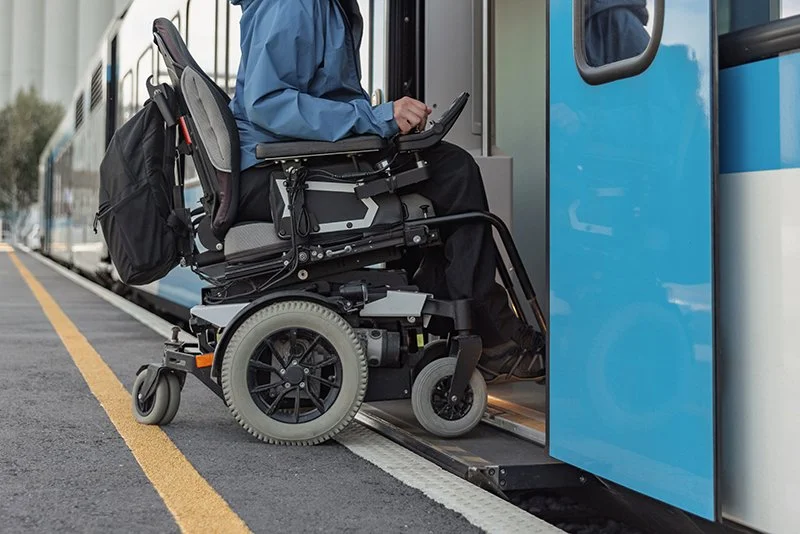
Image: A person in an electric wheelchair moves themselves onto a subway train.
Maya has used a power wheelchair since her early twenties, when a spinal cord injury changed the way she moves through the world. She works as a graphic designer, lives independently, and spends her weekends at farmers' markets and local concerts with her friends.
But getting there takes planning that most people never think about.
Before leaving home, Maya checks whether the venue entrance is step-free, whether the accessible restroom is actually unlocked and usable, and whether the route from the parking lot has a curb cut that isn't cracked or blocked. She maps transit routes in advance, knowing that a single elevator outage can derail an entire trip. She has learned which coffee shops have tables low enough to pull her chair under, and which storefronts have doors too heavy to open independently.
Maya doesn't describe her daily navigation as a burden. She describes it as information gathering and a skill she has developed out of necessity.
"I know my city really well," she says. "I have to."
Her experience reflects what millions of people with mobility disabilities know firsthand: accessibility isn't just a design feature. It's the difference between participating in community life and being excluded from it.
Before the ADA, Accessibility Was Rarely Prioritized
For younger generations, many accessibility features seen in public spaces today may appear normal or expected. However, prior to the passage of the Americans with Disabilities Act in 1990, accessibility was often absent from public planning and infrastructure entirely.
People who used wheelchairs regularly encountered buildings that could only be accessed by stairs. Public transportation systems often lacked lifts or accommodations for riders with disabilities. Sidewalk curb cuts were inconsistent or nonexistent. Blind and low vision individuals had fewer accessible pedestrian signals, less accessible transit infrastructure, and fewer navigation supports. People with disabilities seeking employment were often discriminated against under the rationale that they couldn’t perform due to their disability, and pre-ADA this was often legally permissible.
Many schools, workplaces, theaters, restaurants, and hotels remained inaccessible for decades. Even basic participation in community life could require extraordinary planning or assistance.
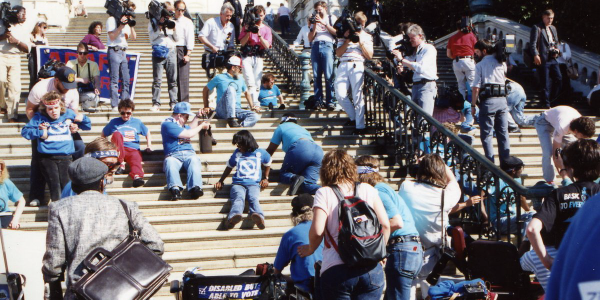
Image: In 1990, Disability Rights activists physically abandoned their wheelchairs and mobility devices and crawled up the stairs of the Capitol building out of protest.
The disability rights movement spent years organizing protests, lawsuits, advocacy campaigns, and demonstrations demanding equal access and civil rights protections. One of the most recognized moments in disability rights history occurred in 1990 during the Capitol Crawl, when disability rights activists with mobility disabilities physically crawled up the steps of the United States Capitol to demonstrate the barriers people with disabilities faced every day.
The passage of the ADA marked a historic shift in how accessibility and disability rights were viewed in the United States. According to the United States Department of Justice, the ADA was created to ensure equal rights and opportunities for people with disabilities in employment, transportation, government services, telecommunications, and public accommodations.
The ADA transformed public expectations around accessibility, but perhaps more importantly, it changed the broader cultural understanding of disability itself. Accessibility began to be viewed not as a favor or accommodation, but as a civil right.
Accessibility Standards Have Reshaped Public Spaces
Many accessibility features now considered standard were once the direct result of years of advocacy from disability communities.
Curb cuts, ramps, elevators, automatic doors, accessible parking spaces, braille signage, tactile paving, wheelchair accessible restrooms, and audio transit announcements became more common because people with disabilities fought to be included in public life.
Today, accessibility standards influence how public buildings, transportation systems, sidewalks, schools, and businesses are designed. Public transportation systems increasingly include wheelchair lifts, kneeling buses, visual and audio stop announcements, and priority seating. Blind and low vision travelers may encounter tactile warning surfaces, accessible pedestrian signals, braille signage, and navigation supports integrated into transportation systems. New technology has emerged and been adopted by airports and retailers, which creates broader accessibility for patrons with disabilities.
Importantly, research and lived experience continue to demonstrate that accessibility benefits entire communities, not only people with disabilities. Parents pushing strollers, older adults, travelers carrying luggage, delivery workers, and individuals recovering from temporary injuries all benefit from accessible infrastructure. Accessibility improves usability for everyone.
Understanding Orientation and Mobility
For individuals who are blind or have low vision, Orientation and Mobility training, commonly referred to as O&M, plays a critical role in independent navigation and travel.
Orientation refers to understanding one’s location in space and developing awareness of the environmental surroundings. Mobility refers to the ability to move safely and effectively through those environments. O&M primarily focuses on how to navigate your environment using a white cane.
Certified Orientation and Mobility specialists teach skills such as route planning, environmental awareness, street crossing techniques, public transportation navigation, spatial orientation, and problem-solving in unfamiliar spaces. Training may also include the effective use of other mobility tools or guide dogs.
The white cane remains one of the most recognized mobility tools associated with blindness, yet it is often misunderstood by the public. A white cane is not a symbol of helplessness or dependence. It is a highly effective mobility tool that provides information about terrain, obstacles, elevation changes, curbs, and surroundings. For many blind and low vision individuals, it represents autonomy, confidence, and freedom. To learn more, check out this video of Marcy, who shares her experience with using a white cane and the training she received.
Today, with advances in technology, some white canes have many functions beyond feeling the immediate surface ahead. Called smart canes, features include sensing objects that could hit your head, vibrating when an object is traveling through the air at you, some have GPS and can talk to you to tell you where to go, an SOS button, what shops or features are nearby, or provide current info on public transportation. With the advent of AI, smart canes are becoming terrain- and risk-predictive, warning users of upcoming hazards and other features. A cane with a green band usually indicates someone who is blind, while a cane with a red band usually indicates someone who is deafblind.
Guide dogs also play an important role for some individuals, helping navigate obstacles and support safe travel. See this video about Service Dogs to learn more.
However, mobility is highly individualized. Not every blind person uses a guide dog, and not every mobility aid works for every disability.
Mobility devices and adaptive tools are extensions of personal independence. Disability advocates continue emphasizing the importance of respecting those tools and personal boundaries. It is never appropriate to move someone’s wheelchair without permission, grab a person’s white cane, or distract a working service animal.
Advances Shaping the Future of Accessibility and Mobility
Over the past several decades, accessibility conversations have expanded far beyond minimum compliance requirements. Increasingly, advocates, researchers, designers, and technology developers are reimagining what truly inclusive communities can look like when accessibility is integrated from the beginning rather than added later as an afterthought.
This shift reflects a growing understanding that accessibility is not only about removing barriers for people with disabilities. It is also about creating communities that are more flexible, safer, and more usable for everyone.
The Growing Importance of Universal Design
One of the most influential concepts shaping modern accessibility conversations is Universal Design. Universal Design refers to designing environments, systems, and products that are usable by as many people as possible, regardless of age, ability, or circumstance.
Rather than designing spaces around one “standard” user and adding accommodations later, Universal Design encourages accessibility to be built into the design process from the start. The goal is not simply compliance with disability laws, but the creation of spaces and systems that work better for everyone from the outset.
Examples of Universal Design appear throughout daily life. Automatic doors assist wheelchair users, but they also help parents with strollers, travelers carrying luggage, and workers moving equipment. Captions on videos support Deaf and hard-of-hearing individuals, while also helping people learn new languages or watch content in noisy environments. Curb cuts support wheelchair users, but they also benefit cyclists, delivery workers, and older adults.
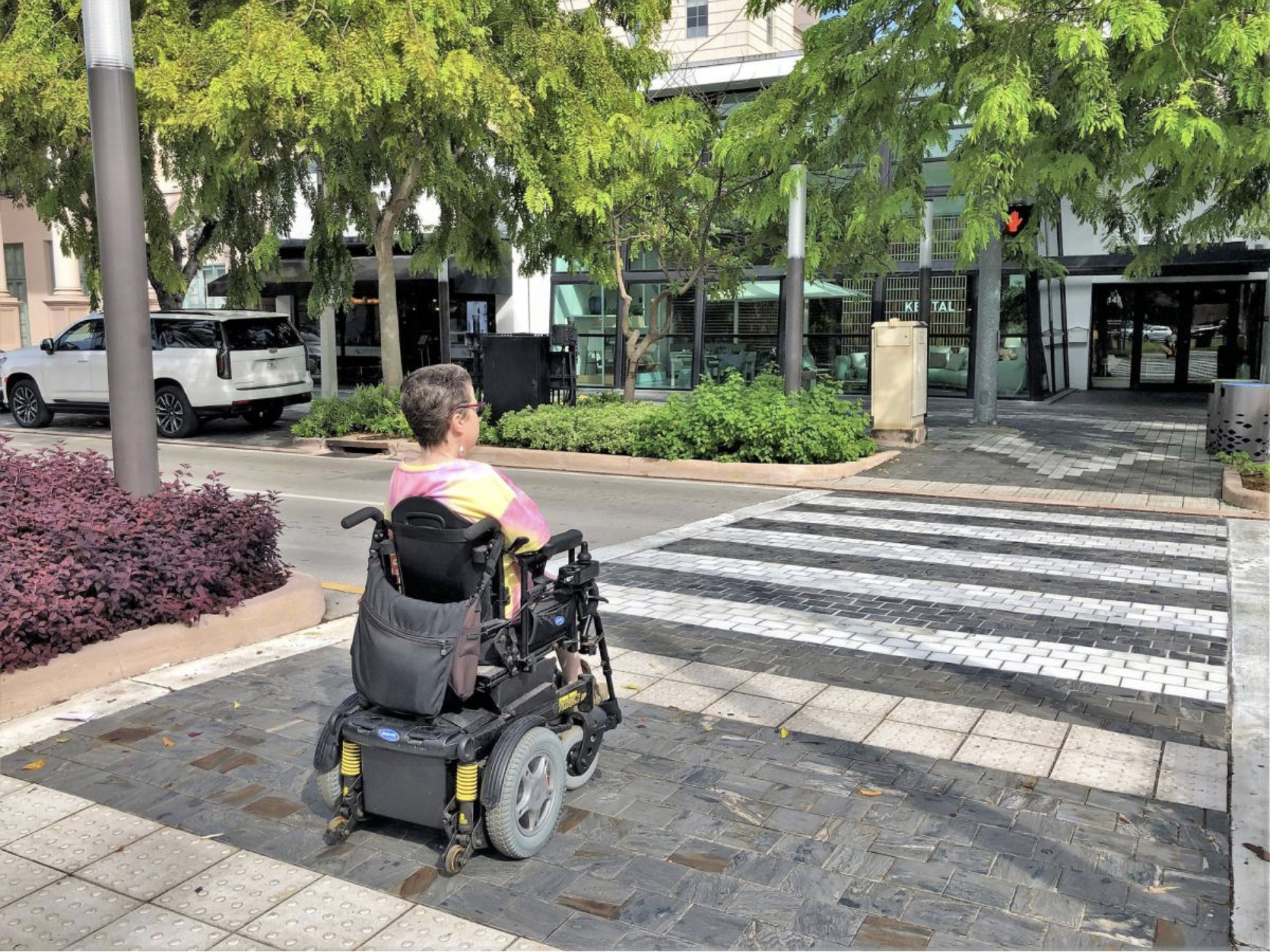
Image: A wide, safe-have median protects wheelchair users on the Miracle Mile in Coral Gables, Florida.
Universal Design recognizes that disability is a natural part of the human experience. At some point in life, most people will experience temporary or permanent changes in mobility, vision, hearing, cognition, or physical ability. By designing communities with accessibility in mind from the beginning, society becomes more inclusive and more functional for everyone.
In recent years, conversations around Universal Design have also become increasingly connected to public policy, housing accessibility, and urban planning. Advocates across the United States continue pushing for legislation and building standards that expand accessible and inclusive design beyond minimum ADA compliance requirements.
One example is the growing movement toward accessible and adaptable housing standards. Organizations such as the National Association of Home Builders and disability advocacy groups have supported initiatives encouraging “visitability” features in homes, including step-free entrances, wider doorways, and accessible first-floor bathrooms. These features allow homes to be more accessible not only for people with disabilities but also for aging adults and multigenerational families.
In Colorado, lawmakers recently passed HB25-1030, Accessibility Standards in Building Codes, which requires local governments that adopt or amend building codes to meet or exceed current international accessibility standards. State leaders described the legislation as part of a broader effort to create communities where people with disabilities and aging adults can live more independently and safely.
Colorado legislators also introduced SB26-109, Building Code Accessibility, which focuses on strengthening standards for accessible housing supported by public funding. The legislation includes updated definitions, implementation requirements for accessible housing units, and clarification of standards intended to better serve people with mobility disabilities.
At the federal level, lawmakers have also introduced legislation connected to more accessible housing development. The Point-Access Housing Guidelines Act of 2025 proposes federal guidelines through the Department of Housing and Urban Development focused on accessibility considerations in multifamily housing design.
According to the U.S. Census Bureau, adults over age 65 are one of the fastest-growing population groups in the country, increasing conversations around aging in place and long-term accessibility planning.
Disability advocates continue emphasizing that accessibility should not be viewed as a specialized feature benefiting only a small portion of the population. Instead, Universal Design reflects the understanding that inclusive environments create stronger, safer, and more adaptable communities for everyone.
Technology Is Expanding Mobility Access
Technology is also rapidly transforming mobility and accessibility for many people with disabilities.
For blind and low vision users, smartphone navigation apps now provide audio directions, text reading, object recognition, color identification, and real-time environmental descriptions. GPS systems designed specifically for blind travelers can help users locate intersections, identify nearby businesses, and navigate public transportation more independently.
AI is creating additional accessibility tools that can interpret visual environments, read printed materials aloud, identify objects, and assist users in navigating unfamiliar spaces. To learn more, check out our previous article How AI Is Changing Accessibility: Progress, Challenges, and the Path Ahead.
Wheelchair technology has also evolved significantly in recent years. Modern power wheelchairs may include customizable seating systems, terrain adaptation, pressure management systems, standing functions, and smart technology integration.
Exoskeleton technology is also emerging as a developing area within mobility innovation. Some wearable robotic systems are designed to support individuals with spinal cord injuries or mobility impairments during rehabilitation or assisted walking.
For example, a clinical study published in Spinal Cordexamined individuals with spinal cord injury using a powered overground exoskeleton and found measurable improvements in walking distance, walking speed, and functional independence measures over a short training period. The study also reported that participants were able to complete exoskeleton-assisted walking sessions safely within a structured rehabilitation program.
Public transportation systems are increasingly incorporating accessibility technology as well. Many transit systems now provide real-time accessibility updates, visual displays, audio stop announcements, app-based route planning, and improved paratransit scheduling systems.
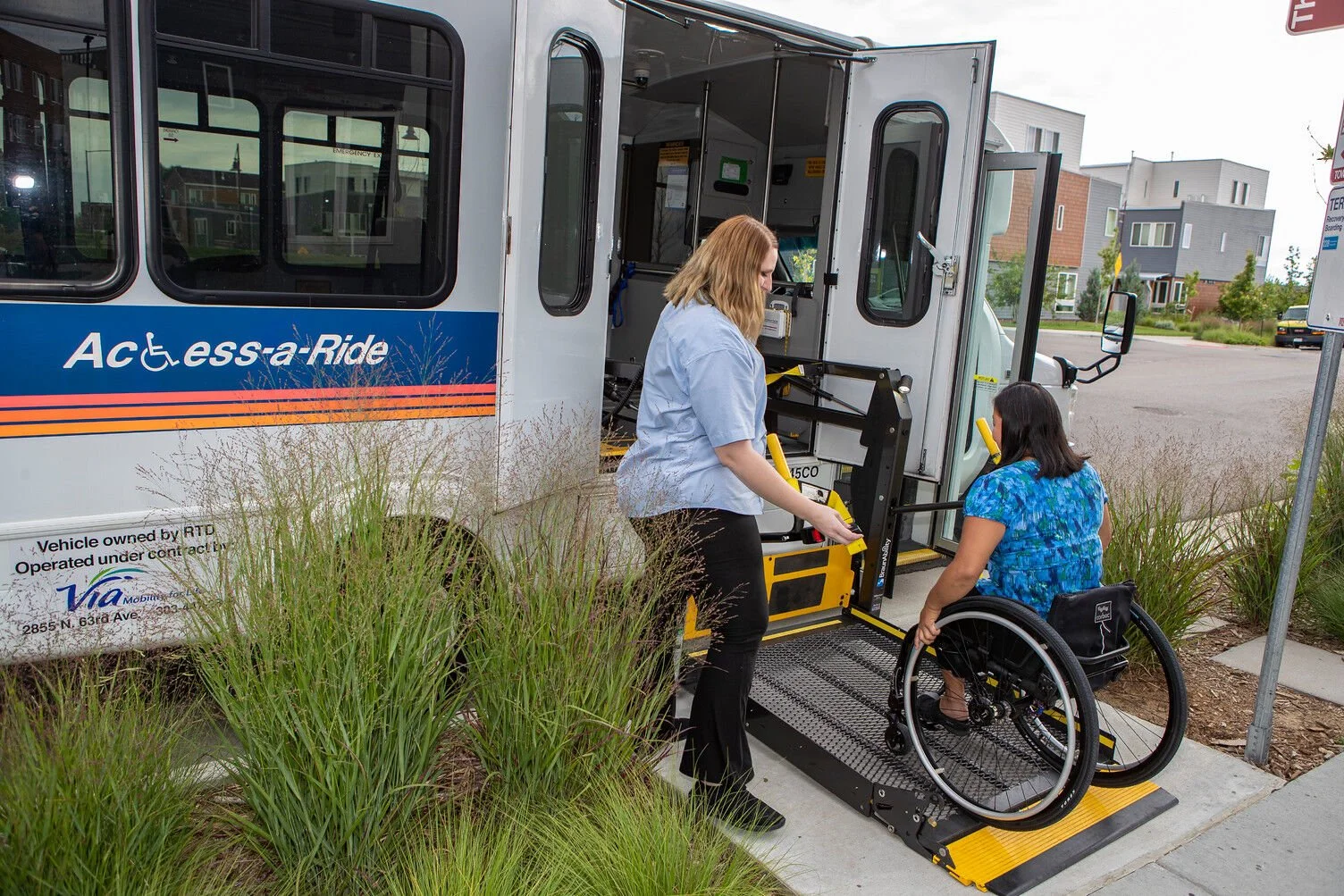
Image: A woman using a wheelchair moves herself onto the lift in order to get on the Access-A-Ride bus. The driver helps operate the lift.
In the Denver metro area, the Regional Transportation District (RTD) operates with accessibility features built into both fixed-route and rail services, including automated stop announcements, visual display systems, accessible boarding ramps, and operator assistance for riders with mobility disabilities. RTD also provides ADA paratransit services such as Access-a-Ride for individuals who are unable to use fixed-route transit independently, along with additional support services designed to expand mobility options. RTD explicitly outlines that all buses and rail vehicles include accessibility features such as audio and visual announcements, wheelchair securement areas, and operator assistance upon request.
Researchers also continue studying how infrastructure impacts mobility experiences differently across disability communities. A recent study examining sidewalk barriers found that people using canes, walkers, scooters, manual wheelchairs, and motorized wheelchairs often encounter very different accessibility challenges depending on their mobility devices and support needs. Researchers emphasized that accessibility planning must account for diverse disability experiences rather than relying on a one-size-fits-all approach.
Barriers and Inequities Still Exist
Despite decades of progress, accessibility barriers remain a daily reality for many people with disabilities.
Inaccessible housing, aging infrastructure, poorly maintained sidewalks, snow obstruction, inaccessible businesses, transportation gaps, and uneven enforcement of accessibility laws continue to limit participation and independence.
Rural communities often face additional challenges due to limited public transportation systems and fewer accessibility resources. Economic disparities can also limit access to mobility devices, assistive technology, adaptive equipment, and healthcare services.
The World Health Organization continues to emphasize that inaccessible environments contribute directly to disparities in education, employment, healthcare access, and social participation for people with disabilities.
Accessibility goes beyond legal compliance. It is about whether communities are designed in ways that allow all people to participate fully and safely in public life.
Mobility Awareness Is About Inclusion
Mobility Awareness is ultimately about recognizing that independence looks different for everyone.
Mobility is not defined by whether someone walks, wheels, uses a white cane, navigates with a service dog, or relies on adaptive technology. Independence is about having the support, access, and opportunity to move through communities safely and fully participate in society.
The progress made since the passage of the ADA demonstrates the power of advocacy, education, and inclusive design. At the same time, the work of accessibility is ongoing.
Inclusive communities are built intentionally through design, policy, technology, advocacy, and a collective commitment to treating accessibility not as an afterthought but as a fundamental part of human inclusion.