

What Is a Disability? It’s a Natural Part of Human Diversity.

Image: A group of CPWD consumers with various disabilities sits and stands near a garden outdoors.
CPWD is a Center for Independent Living with a mission to assist all people with any disability in overcoming barriers to Independent Living. That mission rests on a simple but often overlooked truth: disability is a common human experience, and at the same time, one of the most misunderstood.
When most people picture a disability, they picture a wheelchair. Maybe a white cane or a hearing aid. They picture something visible, something that announces itself. But the reality is far wider, far more varied, and far more human than that single image suggests. Disability includes the person who manages multiple sclerosis on a good stretch and then can barely get out of bed for a week. The Veteran who came home without visible wounds but carries PTSD that affects their ability to live in daily life.. The child with cerebral palsy who plays on the soccer team. The adult with low vision who runs a small business. The person with an intellectual or developmental disability who lives independently, works, and has a full life in the community.
So what, exactly, is a disability? Who gets to say? And why does it matter how we answer those questions?
The Scope of Disability: Bigger Than You Think
Disability is not rare. It is not a niche category. It is, in the most literal sense, a part of everyday American life. According to the CDC, over 28.7% of U.S. adults have some type of disability, and that number only grows as we age. About 16% of adults aged 18–44 have a disability. That increases to 30% among people aged 45–64, and about 50% of all people over 65.
Disability encompasses an enormous range of conditions and lived experiences. The CDC tracks six broad functional types: mobility, cognition, independent living, hearing, vision, and self-care. But those categories don’t capture the full picture. Here is a snapshot of what disability really looks like in this country:
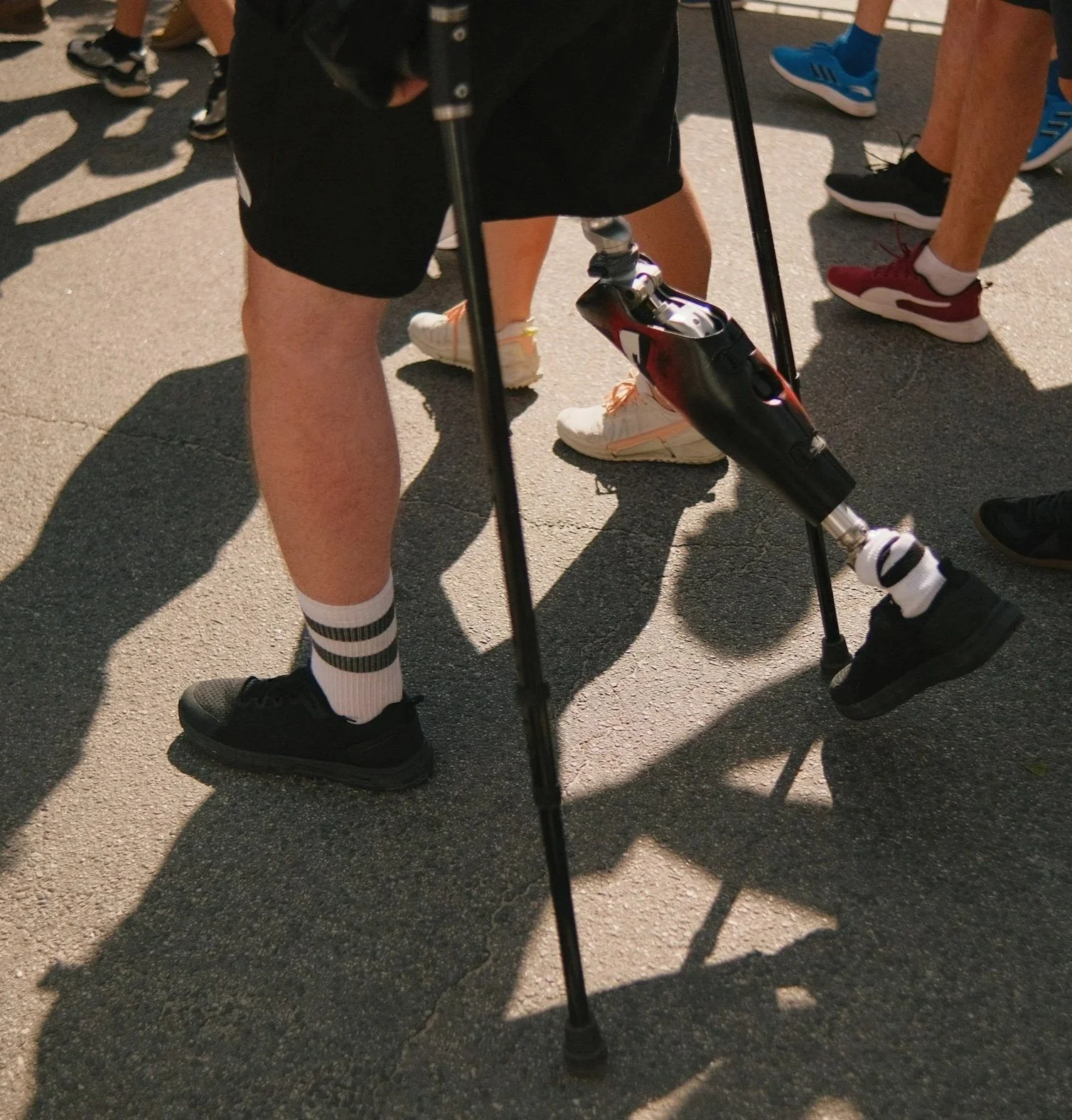
Image: A person is pictured from the waist down walking with a prosthetic leg and crutches.
Mobility disabilities affect 12.2% of U.S. adults with serious difficulty walking or climbing stairs.
Cognitive disabilities affect 13.9% of adults, with significant difficulty concentrating, remembering, or making decisions.
Intellectual and Developmental Disabilities (IDD): More than 7 million Americans have an intellectual disability. The most common developmental disability conditions include intellectual disability, Down syndrome, autism, cerebral palsy, and spina bifida.
Cerebral palsy (CP) is the most common physical childhood disability. It affects muscle control and movement, and its presentation ranges from barely noticeable to significantly impairing mobility and daily function.
Mental health conditions: 23.4% of U.S. adults experienced mental illness in 2024 (61.5 million people). This represents more than 1 in 5 adults. That includes depression, anxiety disorders, bipolar disorder, PTSD, ADHD, and more.
Vision disabilities affect 5.5% of U.S. adults, and low vision, which is significant sight loss that cannot be fully corrected with glasses or contacts, affects millions more.
Hearing loss, tremors, multiple sclerosis, chronic pain, traumatic brain injury: these are all disabilities, too. Some are diagnosed early. Some emerge later in life. Some fluctuate day to day.
Disability is not a fixed identity assigned at birth. It is a dynamic human experience, and anyone can become part of this community at any point in their life.
What Is a Disability, Legally? The Two Definitions You Need to Know
Here is where confusion arises. In the United States, “disability” has two very different legal meanings depending on which law you’re talking about
The ADA Definition: Broad and Rights-Based
The Americans with Disabilities Act (ADA), passed in 1990 and strengthened by the ADA Amendments Act of 2008, defines disability as a physical or mental impairment that substantially limits one or more major life activities. This includes examples such as working, sleeping, walking, breathing, concentrating, communicating, and caring for oneself.
Importantly, the ADA does not provide a fixed list of qualifying conditions. If your condition substantially limits a major life activity, even intermittently, even on the good days when it seems invisible, it likely qualifies. The ADA also protects people who have a history of such an impairment (such as cancer in remission) and people who are perceived by others as having a disability.
The ADA is a civil rights law. Its purpose is to prevent discrimination. Under the ADA, people with disabilities are entitled to reasonable accommodations at work and in educational settings, equal access to public spaces, and protection from being treated as less than.
The SSI/SSDI Definition: Narrow and Work-Focused
The Social Security Administration (SSA) uses a much stricter definition when determining eligibility for disability benefits through Social Security Disability Insurance (SSDI) or Supplemental Security Income (SSI). For the SSA, a disability must be severe enough to prevent you from engaging in substantial gainful activity, meaning you cannot work, and it must have lasted or be expected to last for at least 12 months.
SSDI is tied to your work history. You must have worked and paid Social Security taxes long enough to qualify. SSI is needs-based and does not require work history, but has strict income and asset limits. As of 2026, the SSI federal benefit rate is $994 per month for an individual. To learn more about SSI / SSDI, read this previous article.
Image: A small blackboard has the words “Social Security Disability Benefits” written on it, with a stethoscope resting on the side.
The process of obtaining benefits is extremely difficult. Only about 20% of applicants are approved on their initial application, even when their disability genuinely prevents them from working. Many people go through multiple rounds of appeal before receiving the benefits they are legally owed.
The key distinction: You can have a disability under the ADA with full legal protections and the right to accommodations and still not qualify for SSI or SSDI benefits. Not qualifying for benefits does not mean you don’t have a disability.
This distinction matters because the benefits system gatekeeping causes people to question whether their disability “counts,” as if a government denial letter determines the truth of their lived experience. It doesn’t, but that is a challenging assumption to overcome when society makes accessing support so difficult.
The Gray Areas: Invisible Disabilities
If disability had a public face, it would be constantly asked to prove itself. And for the millions of people with invisible disabilities, conditions that don’t announce themselves visually, that scrutiny is relentless.
Mental health conditions are also recognized as disabilities. Depression, anxiety, PTSD, bipolar disorder, and ADHD are conditions that can significantly limit major life activities, and they are protected under the ADA. The Mental Health Parity and Addiction Equity Act of 2008 further mandated that mental illness be treated the same as physical illness by insurers and doctors. Yet stigma is a persistent barrier. According to the American Psychiatric Association, more than half of people with mental illness don't receive help for their disorders, with many avoiding treatment out of fear of being treated differently or losing their jobs.

Image: A soldier dressed in military fatigues leans against a door with his hand to his face.
Take PTSD as an example. PTSD is recognized as a disability under the ADA when it substantially limits major life activities. The SSA also considers PTSD a qualifying condition for benefits when its symptoms make it impossible to hold a job. Yet countless people living with PTSD, such as Veterans, survivors of violence and trauma, and first responders, are often told they don’t “look” like they have a disability. They are expected to push through. The idea that mental suffering isn’t “real” suffering is one of the most damaging myths our culture perpetuates. Worse, some of those industries - first responders and military, for example, implicitly incentivize workers to hide their disability and symptoms because they could lose their jobs if they appeared “unstable” in any way.
Other conditions fluctuate in intensity and presentation. Multiple sclerosis, lupus, fibromyalgia, Parkinson’s disease, tremors, low vision, and other conditions don’t follow a predictable script. Sometimes they seem manageable and unapparent, and at other times they are debilitating and obvious. A person with MS might have months of relatively normal function followed by a relapse that significantly impacts their ability to work or move through the world. That fluctuation doesn’t make the disability less real. It makes it more complex and harder to navigate definitions and benefits.
Chronic pain is a disability. Long COVID, which the CDC found affects 10.8% of people with disabilities, compared to 6.6% of those without, is increasingly recognized as a disability for many people. Learning disabilities, ADHD, autism spectrum disorder: these are disabilities, even when the person living with them has developed strategies to manage and thrive.
The question is never, “You don’t look like you have a disability?” The question is: Does this condition substantially affect your life? And if the answer is yes, you belong in this conversation.
You Have the Right to Claim Your Identity
Our culture has a complicated relationship with the word “disability.” For some people, it feels like a label that diminishes them, as something to resist, to fight against, to overcome. For others, it is an identity claimed with pride and power.
The disability rights movement, which gave us the ADA, Section 504 of the Rehabilitation Act, and countless other protections, was built on the principle that disability is not a personal tragedy. It is a natural part of human diversity. The barriers people with disabilities face are not inherent to the disability itself; they are the result of a society that hasn’t evolved to accommodate all of our diversities, disabilities included. When we lower and remove barriers, we find that people with disabilities don’t need to be “fixed,” they just need some equity and inclusion and they can live very successful and fulfilling independent lives. One powerful development of the disability rights movement is a cross-disability identity and pride movement that transcends diagnostic lines. Rather than people with one disability competing with people with a different disability for legal recognition and resources, a unified disability identity advocates for all. A success for one group is a success for everyone.
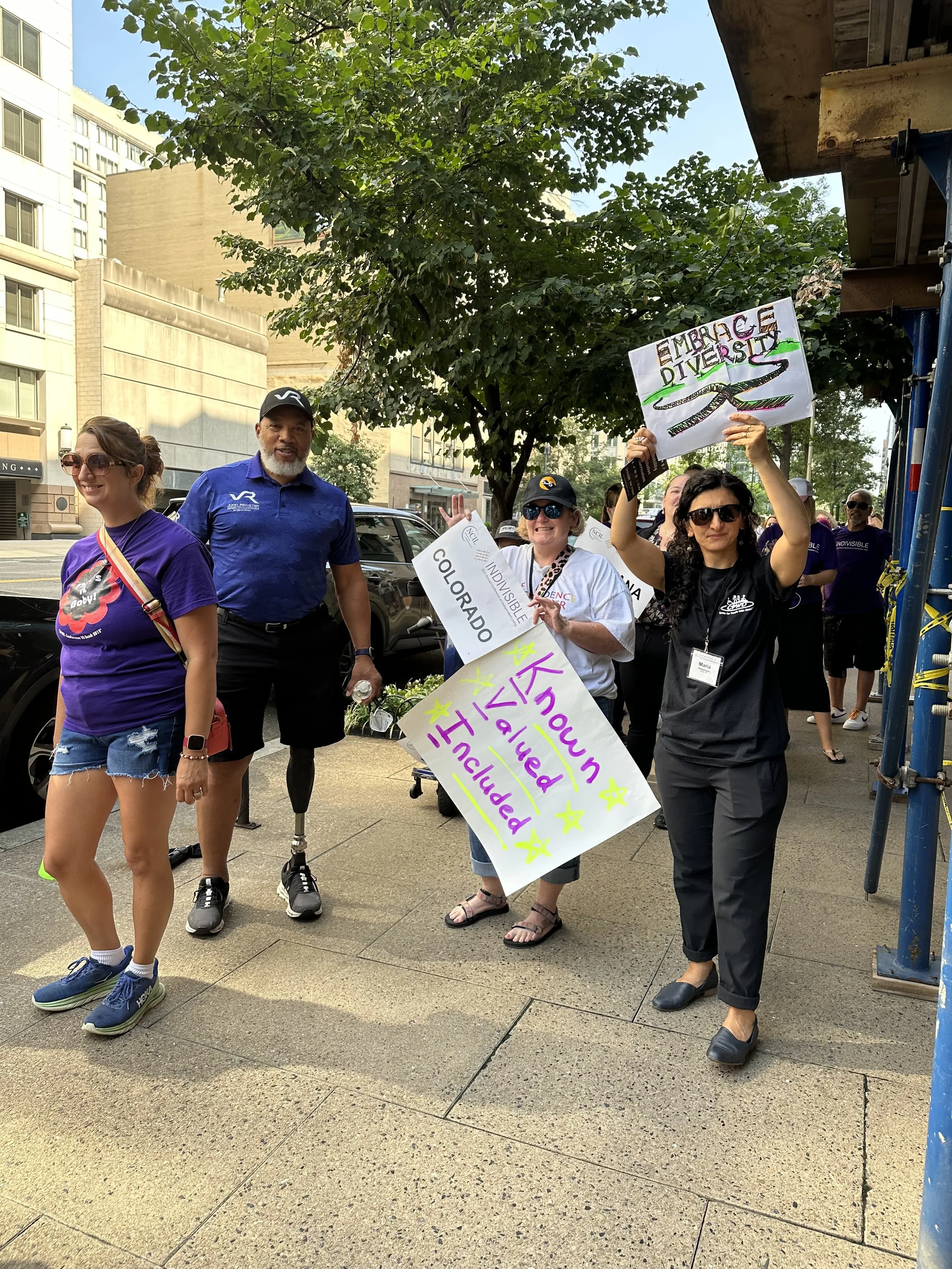
Image: A group of people, including CPWD staff, holds signs at a disability pride rally.
Claiming a disability identity is not a statement of limitation. It is an act of self-advocacy that opens real doors: access to accommodations at work or school, eligibility for services and support, connection to a community that understands, and the power to say clearly, and without apology, this is what I need to participate fully in my life.
Many people resist identifying as having a disability because they fear the stigma, or because they don’t feel that their disability is significant enough. They compare their experience to someone whose disability is more visible, more severe, and more legible to the outside world. But disability is not a competition. The spectrum is wide. Your experience on that spectrum is valid.
You don’t need a diagnosis. You don’t need a benefits approval letter. You don’t need to prove anything to anyone to ask for support, accommodation, and community.
Disability is the largest minority group in the world, and anyone can join at any time.
The Larger Disability Community
As people with disabilities, we know this. We have our own experience, have coworkers, family members, and friends with disabilities. How we act is important. How we meet the world, even in the face of discrimination, affects the cultural perception. We need to carry the energy and message that disability is a natural part of human diversity. That we are capable and valuable. That diversity is a part of life and living, and that we can all learn from and support each other, regardless of abilities. The more we stand with confidence, the more we can weave disability acceptance into our communities. That will support championing laws and funding for equity, accessibility, and accommodations. And that will clear a better path for those who come after us.
At CPWD, we engage in advocacy at a systems level to try to change opinion, dismantle policies that create barriers to independence, and promote policies that support equity, accessibility, and inclusion. We also work with individuals, not only to assist them with skills training, education, and information that will help them achieve independence, but to help them overcome internalized discrimination, find courage and pride, and the confidence to live the independent lives they seek
Whether you are newly diagnosed, managing a lifelong condition, supporting a family member, or just beginning to understand what your experience might mean, we are here. Our peer support, independent living advisors, SSI/SSDI assistance, and community programs exist for the full breadth of the disability experience, not just the visible, the certified, or the officially approved.
Nothing about us without us. We are all in this life, this struggle, this hope, and this triumph, together.