

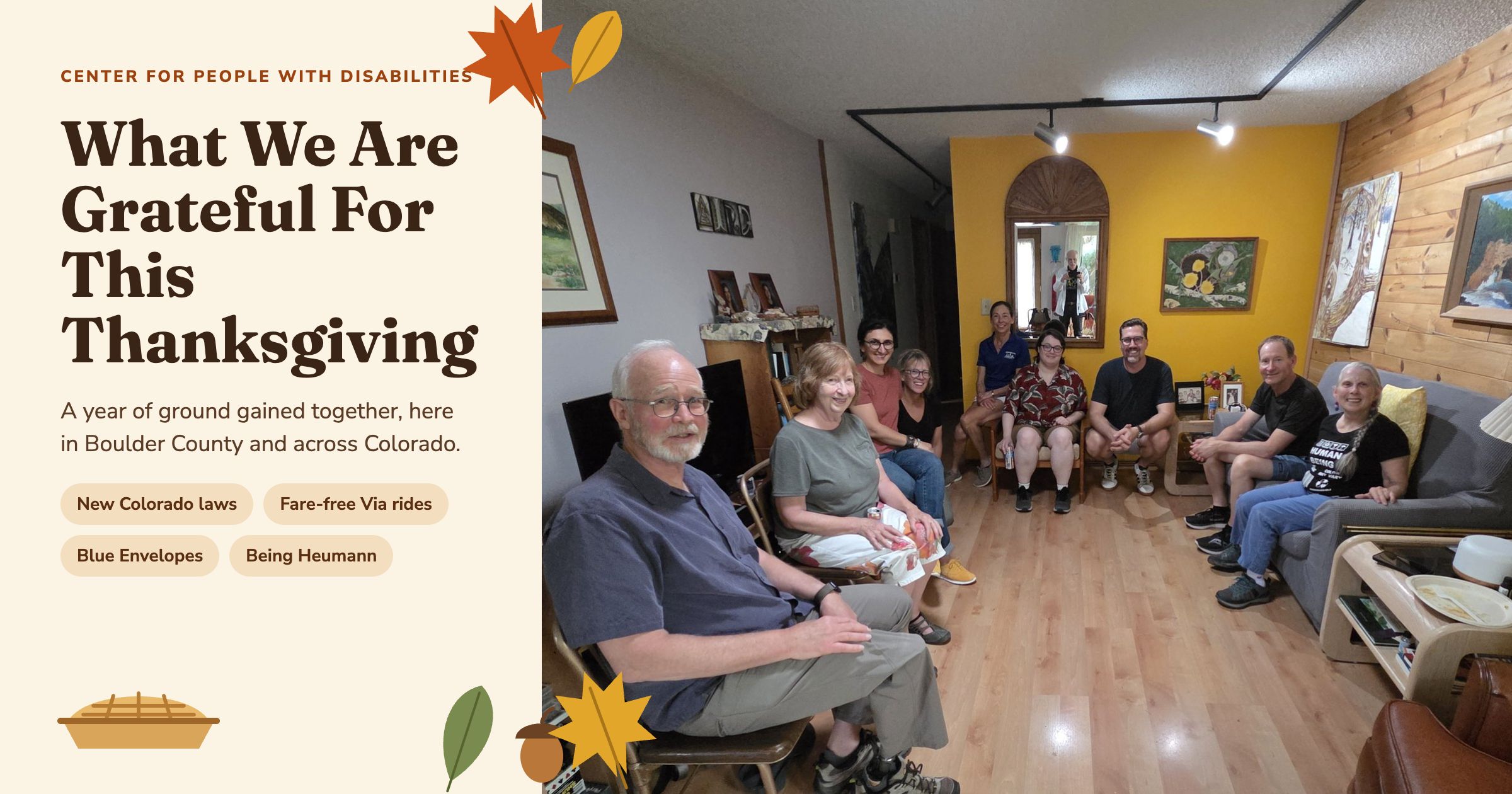
Thanksgiving is a good time for us to reflect on the progress our community has made this year, and there is a lot of it. Colorado passed new laws on disability funding, housing, and schools. Congress kept special education funding in place and changed an age limit that forced some working adults with disabilities to choose between a paycheck and their health coverage. Here in Boulder County, every ride with Via Mobility Services is now free, and the Blue Envelope Program lets us tell officers during a traffic stop how we communicate best and what accommodations we need. Voters also approved a new passenger rail line along the Front Range. A feature film about Judy Heumann and the 504 sit-in reached audiences around the world, with built-in sign language available on Apple TV or Prime Video.
Here are some of the things we are grateful for this year, how they uplift accessibility, equity, and independent living, and some thoughts on how we build from here.
New Laws in Colorado
The 2026 legislative session gave us four laws that strengthen protections we use every day.
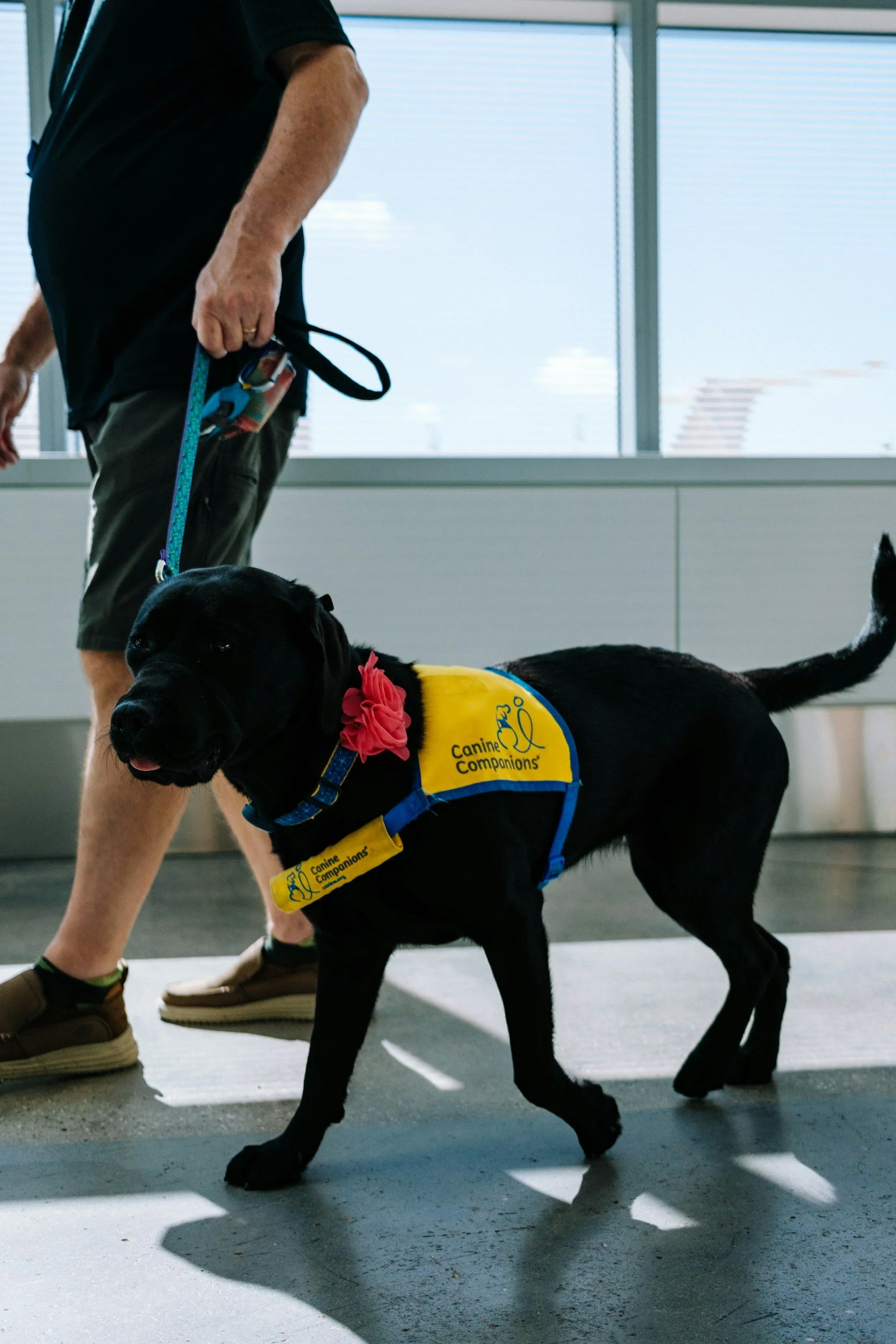
Image: A service dog walks with their person.
HB26-1382, Support of Coloradans with Disabilities. Created the Colorado Disability Funding Authority, which funds groups that help people get and keep benefits, along with programs that expand independence. The funds come from the sale of retired-style license plates and unique vehicle registration numbers, establishing an ongoing source of funding for this initiative.
HB26-1045, Disability Housing Protections. Established clear, legal definitions of assistance animals and emotional support animals in the Colorado Anti-Discrimination Act and outlined how housing providers must consider accommodation requests. A landlord may ask for reasonable documentation only when a disability or disability-related need is not obvious.
HB26-1141, Public Accommodation Protections. Named public schools, colleges, and universities as places of public accommodation, which means discrimination based on disability is prohibited under state law.
SB26-125, Disability Rights Protections in Public Schools. Incorporated large parts of the federal Individuals with Disabilities Education Act (IDEA) into state law and created a state-level complaint process. This bill provides recourse for individuals and families facing discrimination or barriers, such as when a student's Section 504 plan is not carried out, or when a student faces discrimination, retaliation, or harassment based on disability. Emily Harvey, co-legal director at Disability Law Colorado, helped draft it, and Colorado Springs parent Ronnie Broyles testified in both chambers (KOAA).
SB26-125 still needs funding before it can be enforced. The Colorado Department of Education will enforce the law, and the department estimates it needs more than $650,000 to set up the program and more than $500,000 a year to staff it. Governor Polis has said he plans to request that funding in future budgets, and that budget request is where our voices come in next.
For more on these laws and on changes through Community First Choice, see our earlier piece, Benefits in 2026: What Is Changing, What Is Available, and Where to Get Help.
Federal changes that protect work and savings
Special education funding held steady. The Consolidated Appropriations Act, 2026 (H.R. 7148), signed February 3, kept funding for many education and disability-related programs at or near current levels. Congress also declined proposals to cut special education funding or turn it into block grants, after months of advocacy from the disability community (Disability Belongs).
No more age cap on the Medicaid Buy-In. The same law included the Ensuring Access to Medicaid Buy-In Programs Act. Until now, working adults with disabilities could buy into Medicaid from ages 16 to 64, then lost it at 65 and had to choose between their job and the coverage they rely on. The new law lets them keep working and keep their Medicaid after 65 (Rep. Ciscomani). Our benefits counselors can help you see how this applies to Colorado's Buy-In program and when it takes effect for you.
ABLE accounts opened to millions more people. Since January 1, 2026, you can open an ABLE account if your disability began before age 46, up from age 26 (ABLE National Resource Center). An ABLE account lets you save for disability-related expenses without putting SSI or Medicaid at risk. If you were told years ago that you could not open one, it is worth asking again, as that may have changed.
Closer to Home in Boulder County
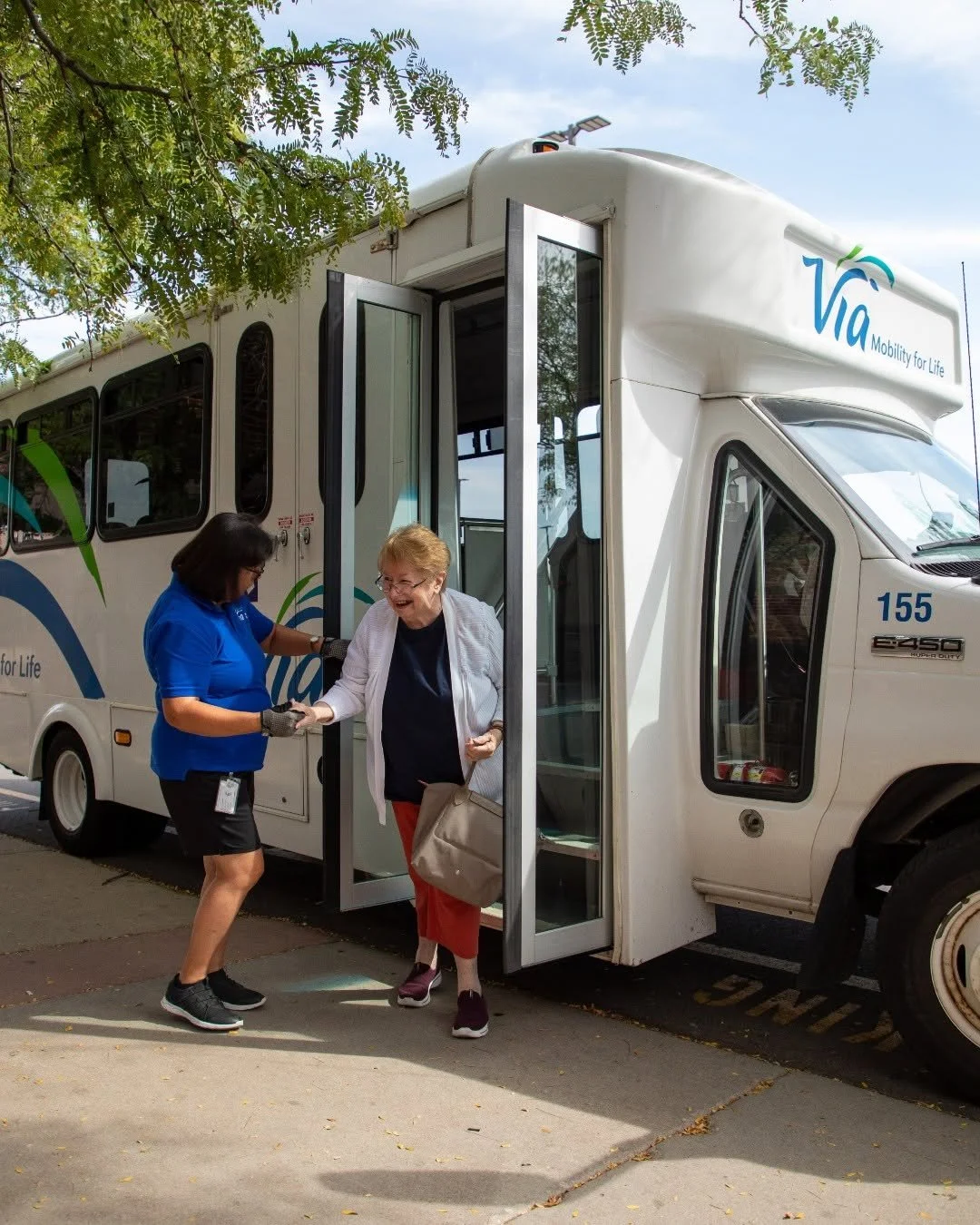
Image: An elderly woman is helped off the Via Mobility Services bus by the driver.
Fare-free Rides with Via
Since September 1, 2025, every ride with Via Mobility Services has been free within its service area. More than 70 percent of Via riders live on less than $30,000 a year, so removing the fare puts medical appointments, jobs, groceries, and time with friends within reach for many of us (Boulder County Mobility and Access Coalition). To learn more or set up rides, visit viacolorado.org.
The Blue Envelope Program Keeps Growing.
The Boulder Police Department launched the first Blue Envelope Program in Colorado in January 2025, and the Boulder County Sheriff's Office followed that spring. You fill out a free blue envelope with how you communicate best and any accommodations you need, keep it in your glove box, and hand it to an officer during a traffic stop. Boulder Police designed the envelopes with disability advocacy groups, including members of the Deaf community, and the program keeps no registry (CBS Colorado, Westword). Agencies across the state have since adopted it, including Fort Collins Police and the Denver Police Department (KUNC).
To get an envelope, email BlueEnvelope@bouldercolorado.gov or stop by the Boulder Police Department at 1805 33rd Street. Outside the city, email the Sheriff's Office at bcso@bouldercounty.gov.
Passenger Rail Along the Front Range.
On November 3, voters in ten counties approved Ballot Issue 7A, a 0.333 percent sales and use tax to build and operate the Colorado Connector, a passenger rail service along the Front Range (Boulder Reporting Lab, Keating Research). For many of us who do not drive, or would rather not drive or hire transportation, a train between our towns means more choices for work, health care, and visits with family. A new line is the best time to get access right, from level boarding to accessible stations and real-time information in audio and visual formats, and we intend to be at the planning table to bring the voice of disability and accessibility.
Being Heumann, with sign language built in
Being Heumann, the new film about disability rights leader Judy Heumann, opened in theaters on November 6 and began streaming worldwide on Apple TV on November 13 (AccessNow). Ruth Madeley plays Heumann, and Siân Heder, who directed CODA, directed the film. It tells the story of 1977, when Heumann and more than 100 activists with disabilities occupied the San Francisco federal building until Section 504 of the Rehabilitation Act was signed (Apple TV).
How the film reaches its audience matters as much as the story it tells. Being Heumann is the first film released with Apple TV's new Sign Language Interpretation feature. Viewers can turn on American Sign Language (ASL) or British Sign Language, and a human interpreter appears in the corner of the screen, with no AI involved (NewsBytes). Deaf and native signers designed and tested the experience, and Daniel Durant, a Deaf actor in the film, directed its sign language interpretation (AccessNow). The built-in ASL option is also available on Prime Video.
For Deaf viewers whose first language is ASL, captions are a translation into a second language. Interpretation inside the player means watching a new release in your own language, on opening weekend, in the same app as everyone else. It is fitting that this started with Judy Heumann. During the 504 sit-in, when the government cut off communication to the building, protesters passed messages to supporters outside using sign language (UW CREATE).
Ruth Madeley put it simply: "The fact that you have an access requirement doesn't mean you have a limitation."
To watch with interpretation: turn on the Sign Language option in the Apple TV app settings, then press the Sign Language button while the film plays. Titles that offer it carry a Sign Language icon, and searching "with ASL" brings up the full collection.
Celebrate the season, your way
This December, more of the Front Range's holiday traditions are open to all of us, with relaxed performances, ASL interpretation, and audio description built into the schedule.
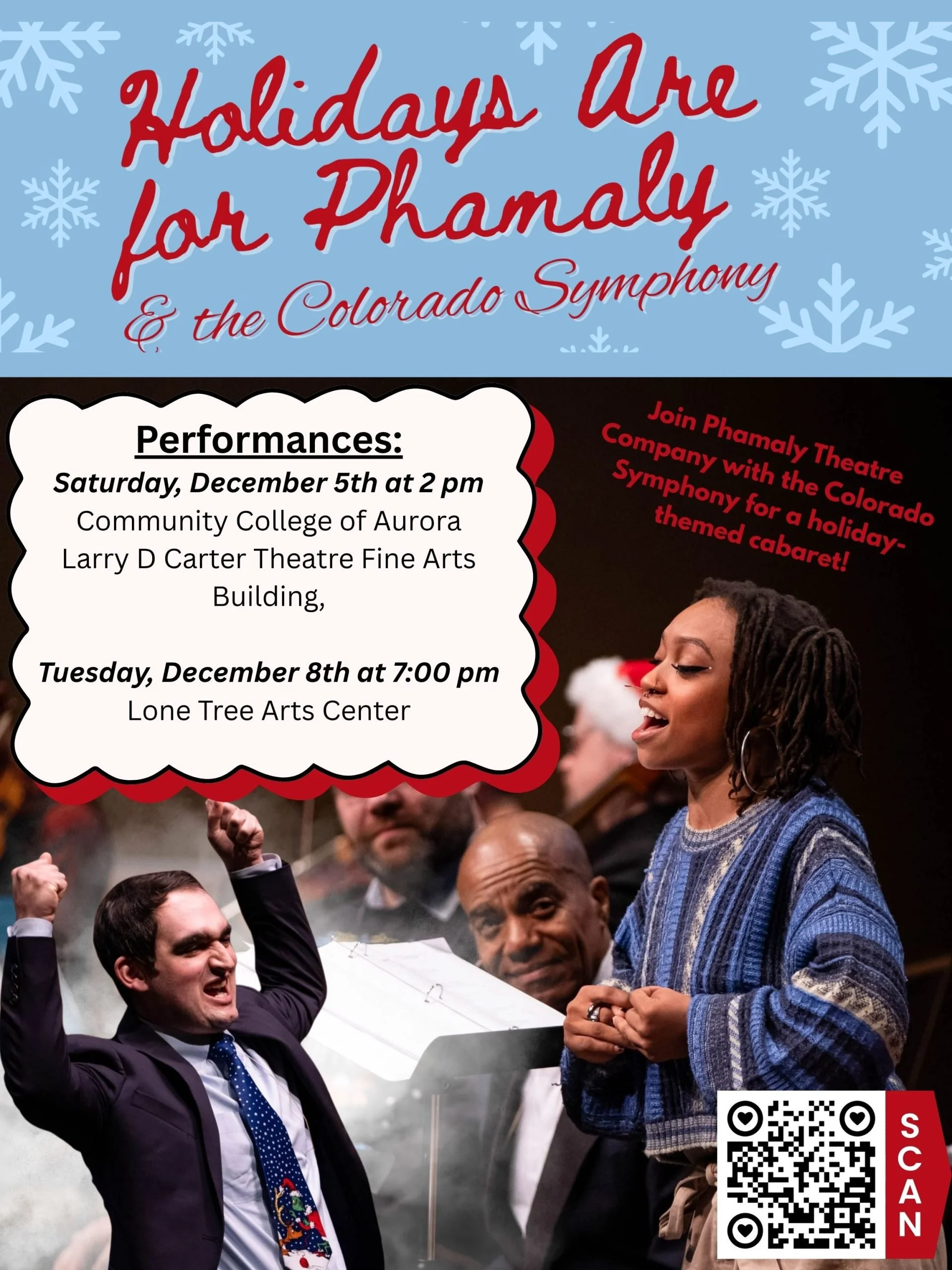
Image: A poster for the event Holidays are for Phamaly with QR code
The Gentle Nutcracker, Longmont. The Longmont Symphony Orchestra and Boulder Ballet present a one-hour, sensory-friendly version of The Nutcracker on Saturday, December 5, from 1:00 to 2:00 p.m. at Vance Brand Civic Auditorium, 600 E. Mountain View Avenue. The lights stay on, and everyone is free to move and dance. Tickets and details
The Holidays are for Phamaly. Phamaly Theatre Company, Colorado's theatre company of artists with disabilities, joins musicians from the Colorado Symphony for a relaxed holiday cabaret on Saturday, December 5, at 2:00 p.m. at the Community College of Aurora's Larry Carter Theater, and Tuesday, December 8, at 7:00 p.m. at Lone Tree Arts Center. ASL interpretation and audio description are available, and audio description should be requested two weeks ahead at info@phamaly.org.
Colorado Ballet's The Nutcracker, Denver. The sensory-friendly performance is Sunday, November 29, at 1:00 p.m., with audio-described performances on Saturday, December 5, and Saturday, December 12, both at 1:00 p.m., at the Ellie Caulkins Opera House. You can find show details here. Accessibility details
Sensory-Friendly Sundays at Fiske Planetarium, Boulder. CU Boulder's planetarium hosts free monthly morning shows with lower sound, dimmed lighting, open doors so families can come and go, and sensory tools on hand. Registration is required and fills quickly. Find dates and registration here.
Blossoms of Light Sensory-Friendly Night, Denver Botanic Gardens. On Tuesday, December 1, from 5:00 to 8:00 p.m., the Botanic Gardens turns down the brightest light and sound effects and limits capacity for a low-stimulation experience. Tickets are $22 to $27, $18 to $23 for members, and free for children 2 and younger. Denver Botanic Gardens also publishes a sensory guide in English and Spanish ahead of the night. Find tickets here.
Zoo Lights Sensory-Friendly Night, Denver Zoo. On New Year's Eve, December 31, from 4:30 to 9:00 p.m., Zoo Lights runs with smaller crowds, no strobing effects, extra lighting along the paths, low-volume music, quiet rooms, and sensory kits available on request. Tickets are $25.95 for adults and seniors, $18.95 for youth, and free for children 2 and younger. Find details and tickets here.
Colorado Gives Day: giving thanks, and giving forward
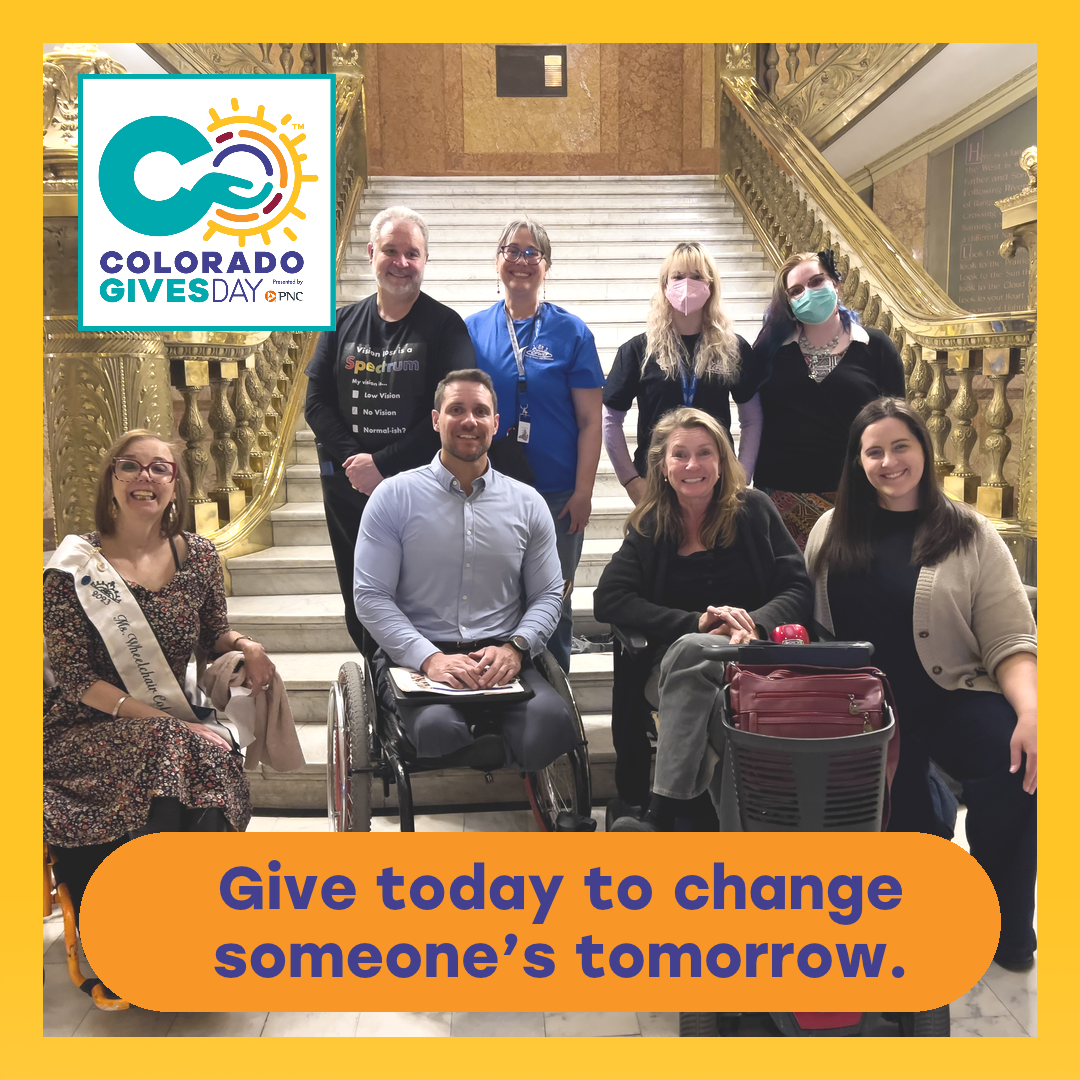
Image: A group of CPWD staff and consumers sits inside the Denver Capitol during Disability Rights Advocacy Day.
Every positive change featured in this article happened because people showed up. They testified at the Capitol, called their legislators, sat on advisory boards, and told us about their barriers to independent living. We are grateful to every one of you who brought your voice, person, or story to the table, and to the donors and volunteers who keep this work going all year.
CPWD has been assisting people with disabilities in overcoming barriers to independent living since 1977. We’ve been advocating for changes like the ones mentioned here at the local, county, state, and federal levels. Close to 75% of our staff and board are people with disabilities, bringing rich lived experience to our efforts. That lived experience shapes everything we offer, from our programs and direct services to systems advocacy, to the voice we bring and what we represent in the many communities we participate in.
Colorado Gives Day is Tuesday, December 8, and early giving is already open. Gifts made through ColoradoGives.org during the Colorado Gives Day event are boosted by a statewide Incentive Fund, helping donations to CPWD between now and December 8 go even further to support this important work. Please support CPWD this season. Gifts can be made at coloradogives.org/cpwd. Sharing our page with friends and family helps too. Thank you.
How we keep building
Every item on this list started with someone naming a barrier and refusing to accept it, from Judy Heumann in 1977 to the parents and advocates who testified for SB26-125 this past spring. Here is how you can be part of what comes next.
Sign up for our advocacy updates. Funding for SB26-125 enforcement and the rules for Community First Choice will move through budgets and comment periods in the year ahead, and our updates will reach you while there is still time to act. You can bring your voice, feedback, and concerns to open comment periods, and that will influence the final decisions.
Ask about the Medicaid Buy-In and ABLE changes. Our benefits counselors can walk you through what they mean for you. Call (303) 442-8662, extension 233, or email benefits@cpwd.org.
Tell us about a barrier you are running into. Systems advocacy starts with someone naming the problem. Reach us at (303) 442-8662 or INFO@CPWD.ORG.
Offer peer support to someone who is newer to navigating disability, benefits, or independent living.
Thank you for being part of this community. From all of us at the Center for People With Disabilities, Happy Thanksgiving.