

You Don’t Need to See to Believe: Understanding Invisible Disabilities
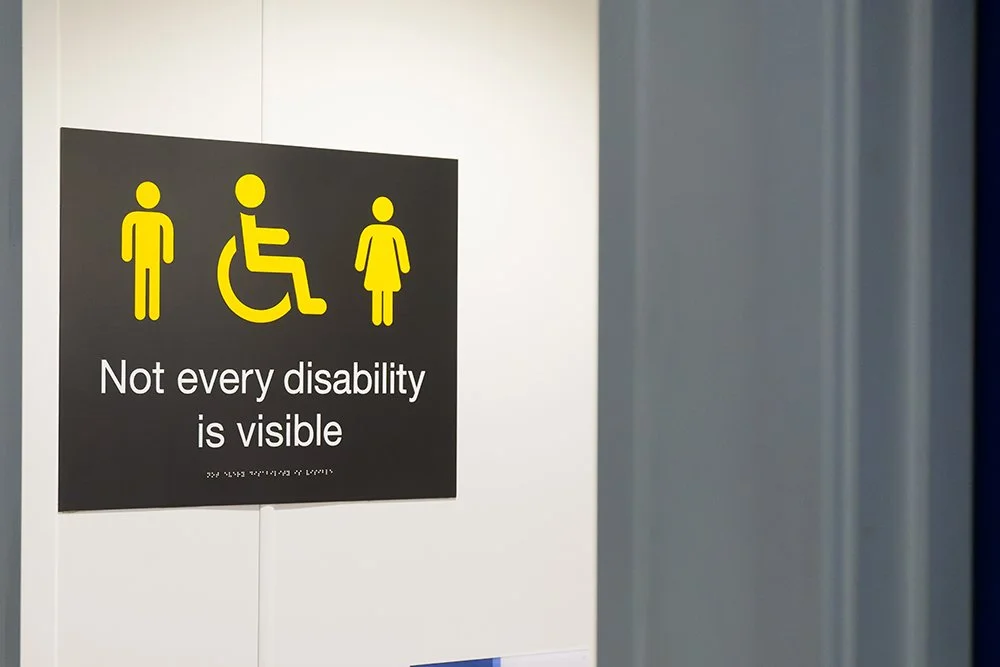
Image: A sign on a wall shows yellow icons representing a man, a wheelchair, and a woman, and underneath it reads: “Not every disability is visible.”
Aligned with the Independent Living Philosophy, CPWD believes that every person has the right to live independently, to take full part in community life, and to be the author and expert of their life experiences. This tenet of respect becomes more important when we talk about invisible disabilities, or disabilities that may not have external characteristics that others can see and acknowledge. Allowing people with disabilities to have, share, and be heard on their lived experience without judgment or evaluation based on perception is vital to a community that values inclusion and equity.
Not all disabilities are visible. Not all disabilities require a ramp or captions. Disabilities such as chronic illness or pain, neurological conditions, mental health conditions, sensory processing conditions, and autoimmune conditions all exist beyond the average person's perceptual ability. These disabilities are hard to see, hear, observe, and confirm. To add challenge, social stereotyping and discriminatory attitudes can lead to some individuals or groups filtering for significant physical disabilities and categorically dismissing individuals without visible disabilities.
At CPWD, as an organization run by people with disabilities for people with disabilities, we understand the importance of honoring someone's own lived experience. We seek to lower barriers to accessing services. The only requirement to receive services from CPWD is to self-identify as having a disability.
In the same way that you don't need a notarized family tree to show that your grandparents were from Spain, or a doctor's note to order gluten-free bread, you don't need to prove to anyone that you have an invisible disability that significantly impacts your ability to perform activities of daily independent living.
Let's explore some of the aspects of invisible disabilities, some of the challenges people with invisible disabilities confront, and some of the solutions and resources that can give us courage and confidence in the face of misunderstanding, and help educate our greater community.
Real, and Rarely Visible
Image: A woman with an invisible disability rests her head on hers arms as she looks out a window.
An invisible disability, sometimes called a non-apparent disability, is any condition that shapes daily life without showing on the surface. Many of us live with one. It might be chronic pain, blood sugar we track all day, the long aftermath of a brain injury, or a nervous system that makes an ordinary room feel louder and brighter than it does to the people around us. From the outside, none of it shows. Because the most familiar symbol of disability is a wheelchair, people have learned to look for a visible marker, and when there is none, they often assume there is no disability at all.
The numbers tell a fuller story. According to the Centers for Disease Control and Prevention, more than one in four adults in the United States, over seventy million people, live with a disability, and a large share of those conditions are ones no one can see. Researchers drawing on CDC and national health data estimate that roughly 51 million adults live with chronic pain, more than 15 million with a serious mental illness, and more than 38 million with diabetes, alongside millions living with autism, epilepsy, traumatic brain injury, and chronic fatigue syndrome. Across our community, invisible conditions are among the most common of all.
A Day Measured in Spoons
One of the clearest ways to describe what an invisible disability asks of us came from a writer named Christine Miserandino. In 2003, she sat in a diner trying to explain to a friend what living with lupus was like. She gathered the spoons from the table and handed them over. Each spoon stood for a unit of energy. A person without a chronic condition moves through the day without counting. However, many of us begin each morning with a limited number of spoons, and every task - showering, making a meal, commuting, holding a long conversation - costs one. When the spoons run out, they are gone, whatever the day still holds.

Image: Multiple spoons rest on a tabletop.
The idea, now known as spoon theory, spread quickly, and many of us call ourselves "spoonies" to this day. Its gift is that it makes something visible that usually is not. What can look from the outside like low effort is often a person spending a scarce, carefully budgeted resource. Some days we borrow against tomorrow, spending energy we do not really have in order to show up today, paying for it with a harder morning after. Most of that planning happens quietly, where no one else can see it.
Many invisible conditions also change from day to day, and even hour to hour. Some of us have started using the term dynamic disability to name this. As the University of Victoria's Society for Students with a Disability describes it in its community-led campaign, a dynamic disability is one whose symptoms fluctuate, where each day is different, and a person may be more limited on Thursday than on Monday. We might use a mobility aid some days and not others, or work a full shift one week and need to stay home the next. The condition moves, and we are simply describing where it is today.
There is also the quiet work of looking well. Many of us put real effort into appearing as though nothing is wrong, steadying our expression through pain, keeping a pace that costs us, saving the hard part for when we are alone. This is often called masking, and it has a price. It spends spoons that could have gone somewhere else, and it tends to hide the very thing that most needs understanding.
"But You Don't Look Sick"
Most of us have heard some version of "but you don't look sick." Often, the commenter means well. But first of all, a disability isn’t a sickness. And second, it points to a real challenge: when a disability cannot be seen, our own account of it becomes the main evidence there is, and that account is not always taken at face value. The philosopher Miranda Fricker gave this pattern a name, testimonial injustice, which describes what happens when a listener gives a speaker less credit than their words deserve because of an assumption about them. Researchers have found the same pattern in health care, where people with pain and other hard-to-measure conditions are sometimes not believed about their own bodies.
It helps to name that experience plainly - at least to ourselves, and if possible in a kind but clear way to the other person - so we can set it down and save our spoons for more important life engagements. Being doubted can lead us to second-guess ourselves or hold back from asking for the support we need. What’s true is that our experience is real, whether or not anyone else can see it. There is good news in the law, too. Disclosure is a choice, and it belongs to us. Under the Americans with Disabilities Act, a person is generally not required to disclose an invisible disability unless and until they ask for a reasonable accommodation. And during a conversation about the accommodation, known as the interactive process, you are free to disclose as much or as little as you wish to establish a professional understanding for the accommodation request.
Solutions and Resources
Understanding invisible disabilities is important. Educating people about related misunderstandings and stigmas is equally important, and something we can all help shift.
For those of us living with an invisible disability, here are some ways to maintain courage, confidence, and kindness as you address a misunderstanding.
You do not owe anyone proof, and your needs are yours to name. For most everyday situations, no diagnosis label or doctor's note is required to ask for what helps, and you get to decide how much of your medical story to share and with whom. Many of us carry a quiet pressure to justify ourselves before we will accept help, as though our own experience were not evidence enough. It is. Naming a need is simply sharing information, and you are allowed to offer only as much of it as you choose. In other words, don’t feel pressured to convince someone who is doubting you. Be clear, calm, and confident in your position, and also try to be understanding of them - they may be uninformed or perhaps even biased through cultural programming. Showing respect for yourself will go a lot further to inspire a change in perception than reactivity.
Find language that fits. The right words can turn a personal/invisible experience into something another person can visualize or better understand. Spoon theory is one example, giving us a simple way to say we are running low on energy today without recounting our entire medical history. Other times, a simple "I need to pace myself this afternoon," or naming the one thing that would help can be enough to address the current need. Not every interaction about a current need has to be a long conversation about the history of your lived experience. You may have heard a friend or a role model clearly and calmly address misunderstandings or discrimination with grace. Feel free to borrow some words, or have a quote handy. Using others’ words or quotes can move the energy out of interpersonal friction and into a philosophical conversation that may be a better starting place to foster understanding.
Know your rights. If you have a basic understanding of the laws, asking for an accommodation feels like an ordinary, practical step, not like asking for a favor. When we understand what the law guarantees, a request stops feeling like an imposition and starts feeling like a way to do our job better, or have easier access to a building, and so forth. It feels like we’re working together. One person needs to leave the meeting by 3:30 to get to their kid’s soccer game; you need an elevator and a ramp to get to the meeting. No big deal. We all have needs; we all work together. When we take on this mode of modeling the expected normalcy of accommodations in society without being coiled and ready to react, we are teaching others through our actions that this is the way it works best, for all of us.

Image: A man listens to his employee as they talk about needed accommodations.
Here are some of the laws regarding accommodations. Familiarize yourself with these, not like a fanged lawyer, but in a layman’s way. That way, you can skillfully bring helpful information about accommodation laws into challenging conversations and misunderstandings.
The Americans with Disabilities Act protects us from discrimination and gives us the right to reasonable accommodations at work, in businesses open to the public, and in state and local government services. Its 2008 update, the ADA Amendments Act, matters especially for invisible and fluctuating conditions, because it makes clear that a condition still counts even when it is episodic or in remission, meaning it comes and goes. A disability that flares one week and quiets the next is fully covered.
Section 504 of the Rehabilitation Act requires any program that receives federal funding, including public schools, colleges, and many hospitals, to provide accommodations. For students, Section 504 and the Individuals with Disabilities Education Act open the door to formal plans and services in the classroom.
The Fair Housing Act gives us the right to reasonable accommodations and modifications where we live, such as an exception to a "no pets" policy for an assistance animal, or a ground-floor unit when stairs are a barrier.
Here in Colorado, the Colorado Anti-Discrimination Act, enforced by the Colorado Civil Rights Division, adds state-level protection in employment, housing, and public accommodations, and gives us somewhere to turn when those rights are not honored.
4. None of these laws ask us to look a certain way to qualify. They ask only that a condition substantially affects a major life activity, and major life activities are ordinary things like working, learning, sleeping, concentrating, eating, or caring for yourself. It does not matter whether anyone else can see the condition, and it does not matter whether it holds steady or comes and goes. You also do not have to navigate any of this alone. If you are unsure what to ask for, the free and confidential Job Accommodation Network helps people think through options, and CPWD's advocates can help you understand and use the protections that fit your situation.
5. Find your people, because connecting with others who share the experience is one of the most reliable ways to loosen self-doubt. In a room where no one needs the whole backstory, the energy we usually spend explaining ourselves can go somewhere better. We hear how others handle a flare, a hard conversation, or a request at work, and we begin to recognize that the doubt we absorbed was never the truth about us. CPWD's Peer Support groups exist for exactly that.
Peer Support is the everyday heart of the Independent Living Movement, and much of it happens in community. There’s something incredibly powerful about supporting each other through these common experiences. In CPWD's Peer Support groups, people with disabilities meet, compare notes, and remember that what cannot be seen is no less real. When we believe in one another, and welcome the wider community to do the same, we build something stronger for all of us: a place where each person is trusted as the author and expert of their own experience. CPWD's Peer Support groups bring people with disabilities together to share experience, build community, and strengthen confidence in self-advocacy. To join one, visit our services calendar to find a group that fits your needs.

Image: one of CPWD’s Beyond Vision peer support groups meets for a trip to the Denver Art Museum.
For the friends, coworkers, and neighbors who want to help, small shifts make a real difference. Start from belief, and take a person at their word about how their body or mind is working. Trade "But you don't look sick" for "What would help?" since one weighs a person and the other opens a door. Leave room for change, because someone who managed well yesterday may need more space today, and both can be true. Offer flexibility, a quieter room, or a remote option without asking anyone to explain why they need it. And stay curious, because a little willingness to learn about invisible disabilities goes a long way toward a community where everyone is included. None of this changes overnight, but it does change, one honest conversation and one small act of trust at a time. The more we believe in ourselves and one another, the less anyone has to prove themselves against doubt. That is the community we are building together, and there is room in it for all of us.